How Many Solar Panels Do I Need to Power a House? (2026 Calculator & Chart)

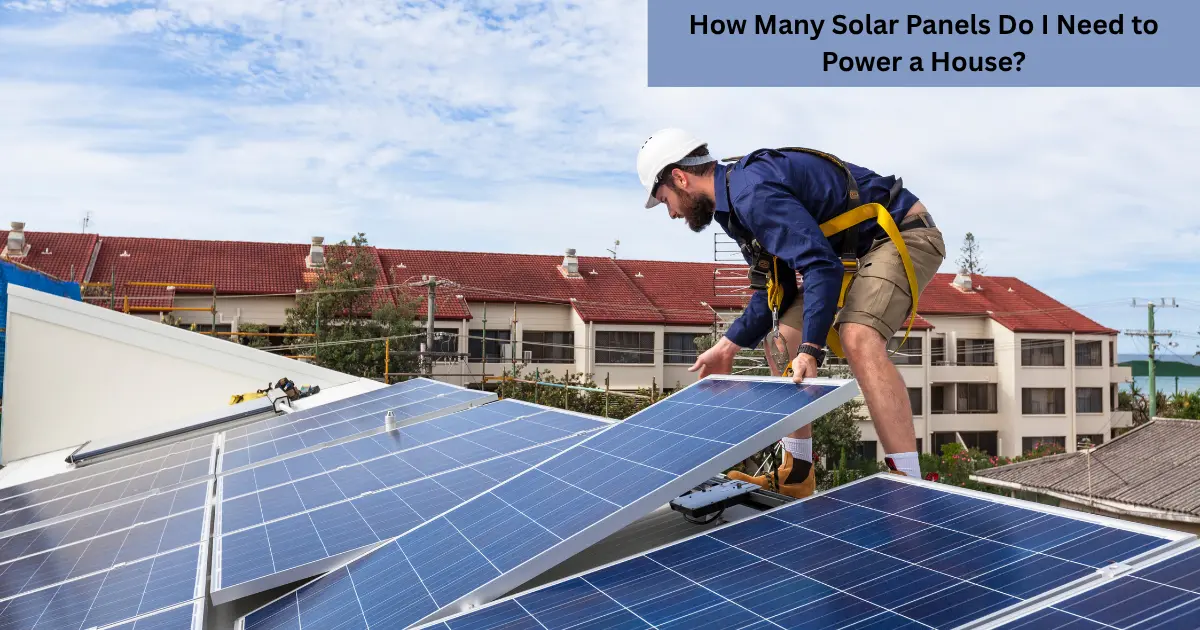
It’s the first question every homeowner asks before going solar: how many solar panels do I need to power my house? The short answer is that most U.S. homes need somewhere between 15 and 25 panels — but the right number for your home depends on how much electricity you use, how much sun you get, and how powerful your panels are. This guide gives you the simple formula, a sizing chart you can read in seconds, and worked examples so you can land on your exact number with confidence.
Quick Answer: How Many Solar Panels to Power a House?
Key Takeaways
The Short Answer: How Many Panels for an Average House?
If you just want a ballpark before doing any math, use the chart below. It maps typical home sizes to their yearly electricity use, the system size that covers it, and the number of standard 400-watt panels you’d need. Once you’ve found roughly where you fit, the rest of this guide shows you how to fine-tune it.
| Home size | Annual use (kWh) | System size | Panels (400W) |
|---|---|---|---|
| Small (apartment, 1–2 people) | ~6,000 | ~4–5 kW | ~11–13 |
| Average (3–4 people) | ~10,800 | ~7–8 kW | ~18–20 |
| Large (5+ people, big home) | ~15,000 | ~10–12 kW | ~25–30 |
| Very large (+ EV, pool, AC) | ~20,000+ | ~13–16 kW | ~33–40 |
These are starting estimates at typical sun levels. A home in sunny Arizona will need fewer panels than the same home in cloudy Seattle, and higher-efficiency panels can trim the count further. Next, let’s turn this into an exact number for your home — it only takes three pieces of information. (Already know your number? Jump to our guide on how to install solar panels.)
The Formula: How to Calculate Your Solar Panel Needs
Behind every solar quote is one simple equation. Once you understand it, you can size a system yourself in about a minute:
Number of panels = Annual electricity use (kWh) ÷ (Production ratio × Panel wattage in kW)
Let’s walk through the example above. Say your home uses 10,800 kWh per year (the U.S. average). You’re installing 400-watt panels (0.4 kW each), and your region has a production ratio of 1.4 — meaning each 1 kW of panels produces about 1,400 kWh per year where you live. Plug it in: 10,800 ÷ (1.4 × 0.4) = 10,800 ÷ 0.56 ≈ 19 panels. That’s a roughly 7.6 kW system.
The whole calculation comes down to three numbers — your usage, your sun, and your panel size. The next three steps show you exactly how to find each one.
Step 1: Find Your Electricity Usage (kWh)
Start with how much electricity you actually use, since that’s what your panels need to replace. Look at your utility bills and find your annual kWh (or take a monthly figure and multiply by 12). The average U.S. home uses about 10,800 kWh a year, or roughly 900 kWh a month — but yours could be far higher or lower. Use the table to place yourself.
| Monthly use (kWh) | Annual use (kWh) | Typical household |
|---|---|---|
| ~500 | ~6,000 | Apartment / 1–2 people |
| ~750 | ~9,000 | Small, efficient home |
| ~900 | ~10,800 | Average U.S. home |
| ~1,250 | ~15,000 | Large home |
| ~1,667 | ~20,000 | Very large home / EV / pool |
This single number is the biggest driver of your panel count, so use your real bills rather than an average if you can.
Step 2: Find Your Sun (Production Ratio)
The same solar system produces more power in Arizona than in Seattle. The production ratio captures this: it’s how many kWh each 1 kW of panels generates per year in your area. Sunnier regions have a higher ratio, meaning you need fewer panels. Use the table to estimate yours.
| Sun level | Production ratio | Example regions |
|---|---|---|
| Very sunny | ~1.6 | Arizona, Nevada, New Mexico, S. California |
| Sunny | ~1.5 | Texas, Florida, Colorado |
| Moderate (most of U.S.) | ~1.4 | Midwest, Mid-Atlantic |
| Lower sun | ~1.2–1.3 | Pacific Northwest, Northeast |
If you’re not sure, 1.4 is a safe national average to start with; a local installer or a tool like NREL’s PVWatts can give you an exact figure for your address.
Step 3: Choose Your Panel Wattage
The more powerful each panel, the fewer you need. Most modern residential panels range from 350 to 470 watts, with 400W being the current sweet spot. Here’s how panel wattage changes the count for that average 10,800 kWh home (at a 1.4 ratio).
| Panel wattage | Panels needed | Notes |
|---|---|---|
| 350 W | ~22 panels | Budget / older models |
| 400 W | ~19 panels | Most common today |
| 450 W | ~17 panels | High efficiency |
| 470 W | ~16 panels | Premium — best for small roofs |
If your roof space is limited, higher-wattage panels let you fit more power into fewer panels — worth the extra cost. With all three numbers in hand, you can now read your exact answer off the sizing chart below.
Solar Panel Sizing Chart (by Monthly Bill)
Here’s the at-a-glance chart most people are looking for. Find your average monthly electricity use (in kWh, from your bill) and read across for the system size and number of 400-watt panels you’d need at a typical 1.4 production ratio.
| Monthly use (kWh) | Annual (kWh) | System size | Panels (400W) |
|---|---|---|---|
| 500 | 6,000 | ~4.3 kW | ~11 |
| 700 | 8,400 | ~6.0 kW | ~15 |
| 900 | 10,800 | ~7.7 kW | ~19 |
| 1,100 | 13,200 | ~9.4 kW | ~24 |
| 1,300 | 15,600 | ~11.1 kW | ~28 |
| 1,500 | 18,000 | ~12.9 kW | ~32 |
Estimates assume 400W panels and a 1.4 production ratio (U.S. average). Sunnier areas need fewer; cloudier areas need more.
How Many Solar Panels to Run Specific Appliances?
Sometimes you don’t want to power the whole house — just offset a specific energy hog like the air conditioner or an EV. Since each 400W panel produces roughly 560 kWh per year (at a 1.4 ratio), you can size for individual appliances too.
| Appliance | Typical annual use (kWh) | Panels (400W) |
|---|---|---|
| Refrigerator | ~600 | ~1–2 |
| Central air conditioner | ~2,000–3,500 | ~4–6 |
| Electric water heater | ~3,000–4,500 | ~5–8 |
| EV charging (home) | ~3,000–4,000 | ~5–7 |
| Electric heat pump | ~3,500–6,000 | ~6–11 |
| Whole average home | ~10,800 | ~19 |
So if your main goal is running the AC on solar, plan for roughly 4–6 panels; adding an EV typically means another 5–7 on top of your base system. Always size up a little for hot summers when AC runs hardest.
How Much Roof Space Do You Need?
Panel count only matters if they’ll fit. A standard residential panel is about 18 square feet, and with spacing you should budget roughly 20 sq ft per panel. Use this to check your roof can hold the system you need.
| System size | Panels (400W) | Roof space needed |
|---|---|---|
| ~5 kW | ~13 | ~260 sq ft |
| ~7.7 kW | ~19 | ~380 sq ft |
| ~10 kW | ~25 | ~500 sq ft |
| ~12.9 kW | ~32 | ~640 sq ft |
Most homes have plenty of roof for an average system. If yours is tight or heavily shaded, higher-wattage panels (450–470W) pack more power into the same space. For the full picture on fitting and mounting, see our step-by-step solar installation guide.
Off-Grid and Battery: Do You Need More Panels?
If you stay connected to the grid, you generally size your system to match your annual usage and let net metering balance day-to-day swings — no extra panels required. Off-grid is different. Without the grid as a backup, you must generate enough to cover cloudy stretches and recharge your batteries, so off-grid systems typically need 25–35% more panels than a grid-tied system for the same home, plus a battery bank sized to several days of use.
Adding a battery to a grid-tied system (for backup power) doesn’t change your panel count much on its own — but if you want the battery to fully recharge from solar each day, build in a little extra headroom.
Factors That Change Your Number
The formula gives a strong estimate, but a few real-world factors nudge it up or down:
| Factor | Effect on panel count |
|---|---|
| Shading (trees, chimneys) | Increases — shaded panels produce less. |
| Roof orientation & tilt | South-facing needs fewer; east/west needs more. |
| Panel efficiency | Higher-wattage panels reduce the count. |
| Future EV / heat pump | Increases — add 4–12 panels for big new loads. |
| Net metering rules | Generous net metering lets you size to annual use. |
| Panel degradation | Slight oversizing covers ~0.5%/yr output loss. |
When in doubt, it’s usually smart to round up slightly — especially if you expect to add an electric vehicle or electrify your heating in the coming years.
Frequently Asked Questions
Conclusion: Finding Your Exact Number
Sizing a solar system isn’t guesswork — it comes down to three numbers and one simple formula. Most homes land between 15 and 25 panels, but your exact figure depends on how much electricity you use, how much sun you get, and how powerful your panels are. Pull your annual kWh off your utility bill, estimate your production ratio (about 1.4 on average), pick a panel wattage, and divide. In under a minute you’ll have a number you can take to any installer with confidence.
The bottom line
Once you know your number, the natural next steps are understanding the solar installation process and costs and how long your panels will last. And if you’re weighing solar as a response to rising bills, see our deep dive on the global energy crisis — going solar is one of the most effective ways to take control of your own energy.
You May Also Like
Do Smart Thermostats Really Save Money? (Honest Answer)

Spray Foam Insulation: Cost, Pros, Cons & Alternatives (2026)
Lithium vs Lead-Acid Solar Batteries: Which Is Best? (2026)