Oversized Furnace Symptoms: Why Bigger Heating Systems Can Perform Worse

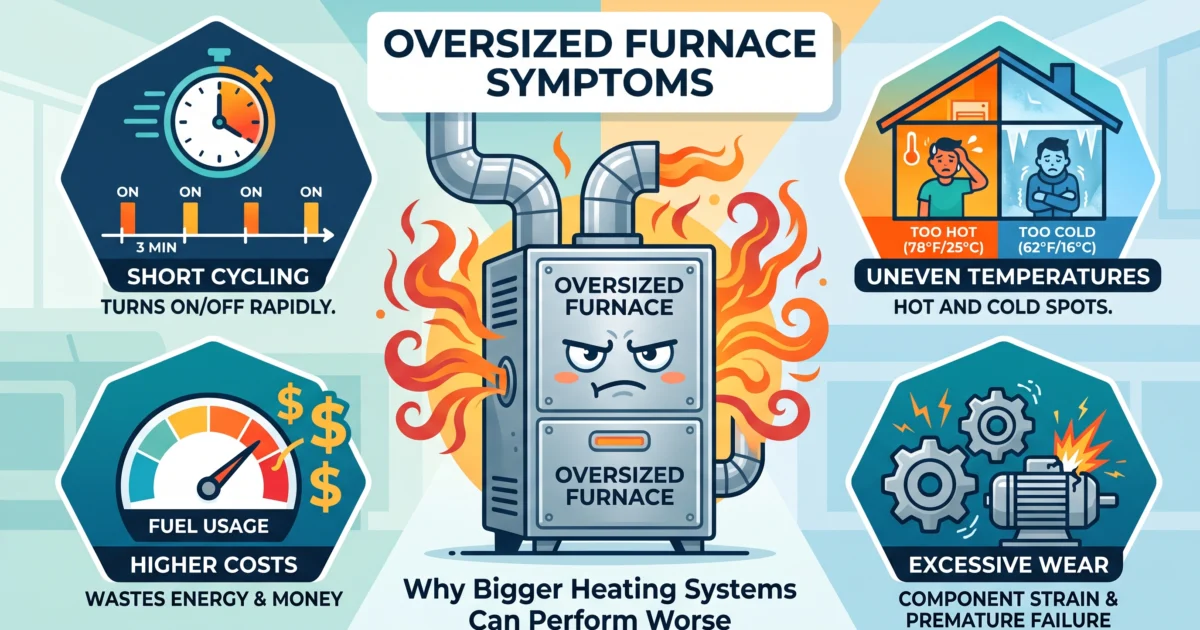
Choosing the right furnace size matters just as much as choosing the right equipment. During furnace installation, an oversized system may seem like a safer choice, but too much heating capacity can lead to short cycling, uneven temperatures, higher operating costs, and unnecessary wear. Understanding the signs of oversized furnace operation can help homeowners recognize when equipment capacity may not match the home.
What An Oversized Furnace Means
An oversized furnace has more heating capacity than the home actually needs under typical winter design conditions. Furnace capacity is usually expressed in BTUs per hour, and the correct size depends on factors such as the home’s square footage, insulation levels, air leakage, window performance, ceiling height, climate, and duct system.
The important number is not simply the BTU rating printed on the equipment, because furnace ratings may refer to input capacity while the usable heat delivered to the home depends on efficiency.
When a furnace is properly sized, it can run for longer, steadier heating cycles that gradually bring rooms to the thermostat setting and maintain that temperature consistently. An oversized furnace delivers heat so quickly that the thermostat may be satisfied before the heat has been evenly distributed throughout the home.
This can create a system that technically produces plenty of heat but does not necessarily provide better comfort. Proper furnace sizing is about matching the equipment’s output to the home’s actual heat loss so the furnace can operate in a stable, efficient range. In many cases, a furnace too big for house heating requirements produces more capacity than the building can effectively use during a normal heating cycle.
Oversizing also exists in degrees. A slightly oversized two-stage or modulating furnace may still operate comfortably at reduced output, while a substantially oversized single-stage furnace must deliver its full capacity every time it turns on. For that reason, maximum BTU capacity alone does not tell the full story about how well a furnace will perform or whether a homeowner will experience oversized furnace problems.
Signs Of Oversized Furnace
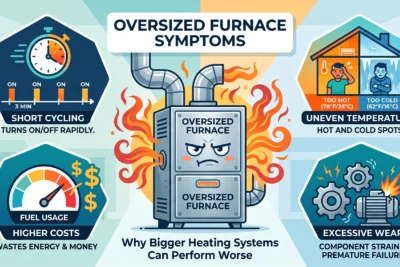
One of the clearest signs is unusually short heating cycles. The furnace may start, run for only a few minutes, shut off, and then restart again soon afterward. This cycling pattern is one of the more recognizable signs of oversized furnace operation, particularly when it occurs during genuinely cold weather.
Homeowners may also notice rooms becoming very warm shortly after the furnace turns on, followed by a noticeable cooling period before the next cycle. Some rooms may heat quickly while others remain cooler because the furnace shuts down before conditioned air has had enough time to circulate throughout the house.
Other possible signs include frequent thermostat activity, loud or forceful blasts of warm air, noisy airflow at supply registers, higher-than-expected heating costs, excessive furnace wear, repeated service calls, and difficulty maintaining even temperatures from room to room. These symptoms are among the common oversized furnace issues homeowners may notice before the underlying sizing problem is confirmed.
Another useful clue is seasonal behavior. A furnace that runs reasonably long cycles during the coldest weather but turns on and off rapidly during mild winter days may simply have far more capacity than the house needs at partial heating loads.
These symptoms do not prove that a furnace is oversized by themselves. Restricted airflow, thermostat problems, thermostat placement, duct issues, dirty filters, zoning problems, safety-limit operation, and other faults can produce similar behavior, so the cycling pattern should be diagnosed rather than assumed. Because several faults can resemble problems with oversized furnace equipment, proper testing is important before deciding that replacement or resizing is necessary.
Why An Oversized Furnace Short Cycles
A furnace cycles according to the thermostat’s demand for heat. When the thermostat detects that the indoor temperature has fallen below the setpoint, it calls for heating. An oversized furnace can raise the temperature around the thermostat very quickly because it is producing more heat than the home requires.
Once the thermostat reaches its target temperature, the heating call ends and the furnace shuts down. Because the furnace may not have run long enough to warm the entire building evenly, some areas of the home can still be relatively cool. The thermostat area then cools again, creating another heating call sooner than would normally occur.
The result can be a repeated pattern of rapid heating, shutdown, cooling, and restart. This repeated cycling is one of the main oversized furnace problems because it can affect both comfort and equipment operation.
There is also another type of rapid cycling that homeowners may mistake for ordinary thermostat cycling. If the furnace generates more heat than the duct system can carry away, the furnace can become too hot and open its high-limit safety switch. In that case, the burners may shut off even though the thermostat is still calling for heat. The blower may continue running until the furnace cools, after which the burners can restart.
That situation can occur when a large furnace is paired with ductwork that cannot move enough air, although airflow restrictions from dirty filters, blocked vents, or blower problems can cause similar symptoms. A furnace oversized for house duct capacity can therefore create operating problems even when the furnace itself is functioning as designed.
That distinction matters because thermostat-driven short cycling and high-limit cycling point to different underlying problems.
Common Oversized Furnace Problems
Oversized furnaces often produce comfort problems because they heat the house too quickly for temperatures to equalize naturally.
Rooms located near the furnace or close to high-airflow supply registers may become noticeably warmer during a heating cycle, while rooms farther away or with greater heat loss may remain cooler. Upstairs and downstairs temperatures can also become more uneven when heating cycles are too short to establish good circulation.
The thermostat may reach its setpoint before walls, floors, furniture, and colder rooms have had enough time to warm. After the furnace shuts off, those cooler surfaces continue absorbing heat from the room, which can make the space feel chilly again even though the thermostat recently showed the desired temperature. This uneven heating is one of the more noticeable problems with oversized furnace systems in homes with rooms that have different heat-loss characteristics.
Short run times can also reduce air mixing through the duct system, which may affect indoor air quality and overall comfort. Since the blower operates for less time, the system has fewer opportunities to move warmer and cooler air between different parts of the house. When a furnace too big for house heating demand repeatedly shuts down before adequate air mixing occurs, temperature differences between rooms can become more noticeable.
How An Oversized Furnace Affects Efficiency And Costs
An oversized furnace can increase operating costs even if its published efficiency rating appears excellent.
Furnaces are generally most effective when they can complete normal heating cycles rather than repeatedly starting and stopping. Every startup involves a sequence of operations that includes the inducer motor, ignition system, burners, and blower. Very short cycles increase the proportion of operating time spent in startup and shutdown rather than steady heating and can reduce the practical benefit of the furnace’s rated efficiency.
The effect on utility bills varies from home to home. Fuel prices, thermostat settings, duct leakage, equipment type, climate, building insulation, and the severity of the oversizing all matter. For this reason, oversized furnace issues do not affect every household’s energy costs in exactly the same way.
Oversizing should therefore be treated as one possible contributor to excessive energy use rather than the automatic explanation for every high heating bill. Other problems should still be ruled out before assuming that a furnace oversized for house heating requirements is solely responsible for increased energy consumption.
Long-Term Oversized Furnace Issues
Frequent cycling increases the number of times furnace components must start and stop, and many mechanical and electrical parts experience their greatest stress during those transitions.
Components that may accumulate additional wear include the igniter, flame sensor, gas valve, inducer motor, blower motor, relays, switches, and control board. Furnaces that repeatedly encounter high-temperature limit conditions can experience additional thermal stress as well. These are some of the potential oversized furnace issues that can develop when excessive cycling continues over long periods.
More operating cycles can eventually translate into more repairs and a greater likelihood that individual components will need replacement during the furnace’s service life. Over time, these repairs can become part of the broader oversized furnace problems associated with equipment that operates far more frequently than necessary.
Oversizing does not guarantee that a furnace will fail early, because maintenance quality, installation, equipment design, airflow, and operating conditions all affect longevity. Persistent short cycling should still be investigated because correcting the underlying cause can reduce unnecessary wear and help the system operate more normally.
The severity matters. A furnace that is only moderately oversized and normally operates on a lower stage may experience relatively little additional cycling, while a large single-stage furnace that starts every few minutes can accumulate far more operating cycles over the same number of heating seasons.
Why You May Have A Furnace Oversized For House
Oversized furnaces are common because heating equipment has historically been selected using rough rules of thumb, square-footage estimates, or the capacity of the previous furnace rather than a detailed heat-loss calculation. As a result, a furnace oversized for house heating needs may remain in service for many years without the sizing problem being formally identified.
Installers may also add substantial extra capacity as a safety margin because they want to avoid the risk of installing equipment that cannot keep up during extremely cold weather. Replacing an already oversized furnace with another furnace of similar capacity can perpetuate the problem for decades.
Homes can also change substantially after a furnace is installed. Air sealing, attic insulation, wall insulation, replacement windows, insulated doors, crawlspace improvements, basement improvements, or major renovations can reduce the building’s heat loss.
A furnace that was reasonably matched to the house years ago can therefore become oversized relative to the home’s new heating requirements. A furnace installed when a house was drafty may be far larger than necessary after a major energy retrofit. In this situation, the homeowner may effectively end up with a furnace too big for house conditions even though the original equipment selection was reasonable at the time.
How To Tell If You Have A Furnace Too Big For House
The most reliable way to evaluate furnace sizing is through a professional heating-load calculation, commonly performed using ACCA Manual J procedures or comparable engineering methods.
A proper calculation considers more than square footage. It evaluates the home’s insulation, windows, doors, orientation, air leakage, construction characteristics, local winter design temperature, ceiling height, and other factors that determine how quickly the building loses heat.
The calculated heating load can then be compared with the furnace’s actual output capacity. Simply comparing BTUs to square footage is not enough. If the furnace output substantially exceeds the calculated load, that can provide strong evidence that the home has a furnace too big for house heating requirements.
Before concluding that the furnace is oversized, a technician should also evaluate conditions that can imitate oversizing, including a dirty or overly restrictive air filter, closed or blocked supply registers, restricted return airflow, undersized or poorly designed ductwork, incorrect blower settings, a malfunctioning high-limit switch, thermostat location or calibration problems, zoning-system problems, duct leakage, and improper gas pressure or burner operation. Several of these faults can create signs of oversized furnace performance even when the equipment capacity itself is appropriate.
A technician should also determine why the furnace is shutting off. If the thermostat reaches its setpoint and ends the heating call, excessive furnace capacity may be involved. If the burners shut down while the thermostat is still requesting heat, the technician should investigate airflow restrictions, blower performance, duct sizing, temperature rise, and high-limit operation.
Cycle length can provide useful evidence, especially when measured during colder weather, but cycle duration alone is not enough to size a furnace accurately. A furnace that operates in very short cycles even during genuinely cold weather deserves closer evaluation. A furnace that cycles more frequently only during mild weather may simply have limited ability to reduce its output.
Static pressure measurements, temperature-rise testing, thermostat checks, and duct inspection can help distinguish true oversizing from airflow or control problems. This diagnostic process is important because problems with oversized furnace equipment and problems caused by restricted airflow can sometimes produce very similar symptoms.
The strongest diagnosis combines a load calculation with inspection of the furnace, controls, airflow, and duct system.
Fixing Problems With Oversized Furnace
The best solution depends on how severely the furnace is oversized, the equipment type, the duct system, the age of the furnace, and whether another problem is contributing to the symptoms.
For some systems, an HVAC technician may be able to improve performance by correcting blower settings, balancing airflow, addressing duct restrictions, relocating or recalibrating the thermostat, or adjusting compatible controls. Two-stage and modulating furnaces may be able to operate at a lower heating output for much of the season, which can reduce some of the comfort problems associated with excess capacity.
A substantially oversized single-stage furnace has fewer options because it cannot reduce its firing rate. Every heating call receives the same full output regardless of whether the house needs a large amount of heat or only a small amount. These measures cannot always correct substantial oversizing. Persistent short cycling after other faults have been ruled out is another of the signs of oversized furnace capacity that may justify a closer look at replacement.
Replacement becomes particularly worth considering when the existing furnace is older, requires frequent repairs, produces persistent comfort problems, repeatedly short cycles after other causes have been ruled out, or is significantly larger than the calculated heating load. In these situations, continuing problems with oversized furnace operation may be difficult to resolve through control or airflow adjustments alone.
When replacement is appropriate, the new system should be selected from a current load calculation rather than from the size of the existing furnace. The duct system should also be evaluated because even properly sized heating equipment cannot perform as intended when airflow is inadequate. Staging or modulation should also be considered because a furnace’s minimum operating capacity can be just as important to comfort as its maximum capacity.
A well-selected system should have enough capacity for the home’s design heating conditions while still being able to operate for long, stable cycles during the much more common periods of partial heating demand. That combination generally provides better temperature control, quieter operation, healthier equipment cycling, and more predictable energy use.
You May Also Like