How Many Weeks in a Year? 52 Weeks and 1 Day (2026 Has 53 ISO Weeks)

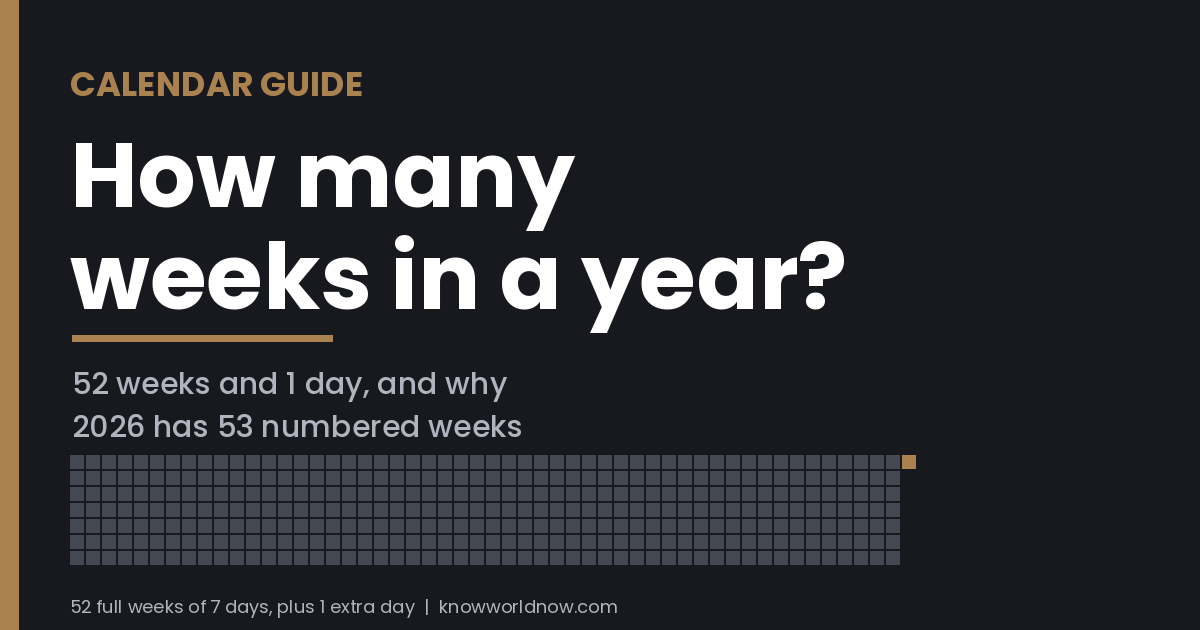
A year has 52 weeks and 1 extra day (52 weeks and 2 days in a leap year). That is 365 days divided by 7, or 52.14 weeks. For most everyday purposes the answer is simply 52 weeks. But 2026 is special: under the ISO week system it has 53 numbered weeks, because it starts on a Thursday. Payroll teams, planners and anyone using week numbers need to know the difference.
This guide gives you the quick answer, a calculator for any year, a live count of weeks left in the year, the reason 2026 has 53 weeks, how many working weeks and pay periods there are, and why 12 months of 4 weeks does not add up to a year.
TL;DR
Weeks in a year calculator
Type any year from 1583 onward to see its length in weeks, its ISO week count, and how many weekdays and weekend days it holds. The second box tells you how many weeks are left in the current year.
Type a year to see the result.
Why a year is 52 weeks and 1 day
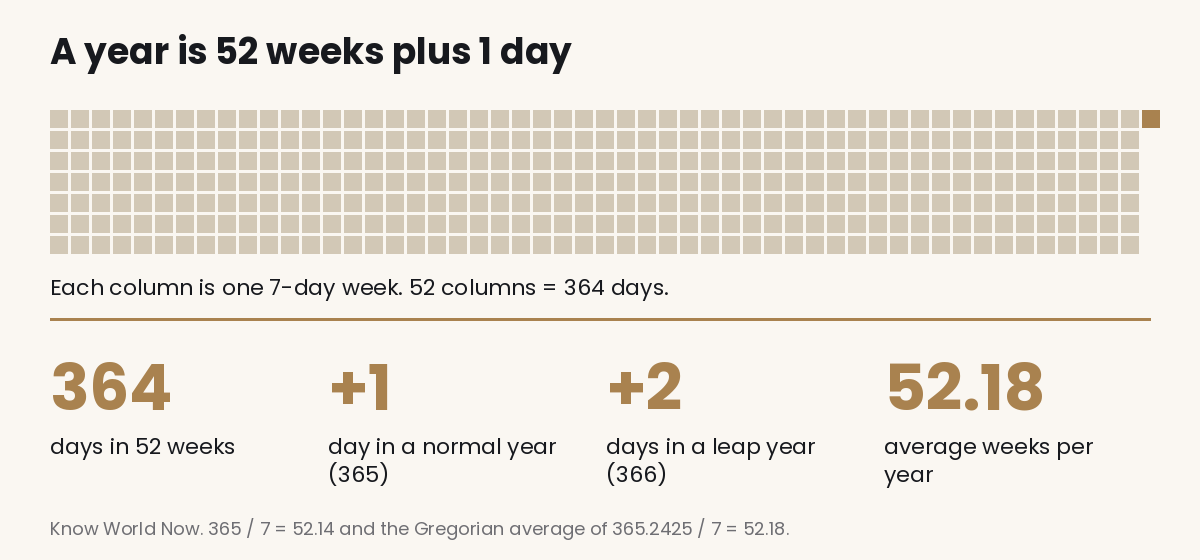
The sum is simple. 52 weeks x 7 days = 364 days, and a normal year has 365 days, so one day is left over. In a leap year there are 366 days, so two days are left over. That extra day or two is why the same date moves forward one weekday each year, and two weekdays after a leap year.
- 365 / 7 = 52.14 weeks in a common year.
- 366 / 7 = 52.29 weeks in a leap year.
- 365.2425 / 7 = 52.18 weeks on average, because the Gregorian calendar has 97 leap years in every 400.
Weeks in a year, 2024 to 2030
| Year | Days | Weeks and days | ISO weeks | Weekdays (Mon-Fri) | Weekend days | Weekday that occurs 53 times |
|---|---|---|---|---|---|---|
| 2024 | 366 | 52 weeks, 2 days | 52 | 262 | 104 | Monday and Tuesday |
| 2025 | 365 | 52 weeks, 1 day | 52 | 261 | 104 | Wednesday |
| 2026 | 365 | 52 weeks, 1 day | 53 | 261 | 104 | Thursday |
| 2027 | 365 | 52 weeks, 1 day | 52 | 261 | 104 | Friday |
| 2028 | 366 | 52 weeks, 2 days | 52 | 260 | 106 | Saturday and Sunday |
| 2029 | 365 | 52 weeks, 1 day | 52 | 261 | 104 | Monday |
| 2030 | 365 | 52 weeks, 1 day | 52 | 261 | 104 | Tuesday |
The last column explains why our guides on Thursdays, Fridays and Mondays in a year give a different answer every year. Weekend counts are in the weekends in a year guide.
Why does 2026 have 53 weeks?
Two different things are being counted. A calendar year always has 52 full weeks plus 1 or 2 days. The ISO 8601 week system, used in business, payroll and much of Europe, numbers the weeks instead. Its rules are:
- Weeks start on Monday.
- Week 1 is the week that contains the year’s first Thursday, which is the same as the week containing 4 January.
- A year has 53 weeks if 1 January is a Thursday, or if it is a leap year and 1 January is a Wednesday.
Because 1 January 2026 is a Thursday, ISO week 1 of 2026 starts on Monday, 29 December 2025, and ISO week 53 runs from Monday, 28 December 2026 to Sunday, 3 January 2027. No days are added. The week numbers simply carry one extra number.
A week is a long time in politics.
A saying attributed to British prime minister Harold Wilson, 1960s
Which years have 53 weeks?
A 53-week ISO year comes around about every 5 to 6 years. Over a full 400-year Gregorian cycle, 71 years have 53 weeks. Recent and upcoming ones are 2004, 2009, 2015, 2020, 2026, 2032, 2037 and 2043.
US week numbers are different
Why a year is not 48 weeks (12 months x 4 weeks)
People often think each month has 4 weeks, so a year has 12 x 4 = 48 weeks. But 48 weeks is only 336 days, which leaves 29 days unaccounted for. Months last 28 to 31 days, so the average month is about 4.35 weeks (52.14 divided by 12). That is why some months fit in five of the same weekday, and why monthly and weekly budgets never line up perfectly.
How many working weeks are in a year?
There is no single answer because it depends on holidays and leave. Here is an illustrative US example for 2026:
| Step | Days | Weeks |
|---|---|---|
| Weekdays in 2026 | 261 | 52.2 |
| Minus 11 US federal holidays | -11 | -2.2 |
| Minus 10 days of paid leave (example) | -10 | -2.0 |
| Working days left | 240 | 48.0 |
So a typical full-time worker has about 48 working weeks a year, and a worker with 4 weeks of leave plus holidays can be closer to 46 or 47. If you are working out hourly pay from an annual salary, a common shortcut is 52 weeks x 40 hours = 2,080 hours, but that includes paid leave.
Weeks in a year for payroll
| Pay frequency | Pay periods a year | Note |
|---|---|---|
| Weekly | 52, sometimes 53 | 53 when your payday weekday occurs 53 times. In 2026 that is Thursday. |
| Biweekly (every 2 weeks) | 26, sometimes 27 | A 27th payday needs a first payday on 1 January in a normal year. In 2026 that means a Thursday payday. |
| Semi-monthly (twice a month) | 24 | Fixed dates, such as the 15th and the last day. |
| Monthly | 12 | One payday a month. |
The reason is arithmetic. Twenty-six biweekly pay dates cover 25 x 14 = 350 days, but a 27th pay date needs 26 x 14 = 364 days between the first and the last, so it only fits when the first payday falls on 1 January in a normal year. In 2026, 1 January is a Thursday, so biweekly Thursday paydays produce 27 paychecks while Friday paydays produce 26.
Budgeting by week or by month?
Weekly budgeting
- Matches how many people are paid
- Catches overspending early
- Easy to track groceries and fuel
Monthly budgeting
- Bills usually arrive monthly
- Months do not divide neatly into weeks
- Fits less well with salaried income
- Easy to forget annual costs
How many weeks are left in 2026?
This table is fixed, so it stays correct all year. Each row counts from the first day of the month through 31 December 2026:
| From | Weekday | Days left | Weeks left |
|---|---|---|---|
| 1 January | Thursday | 365 | 52 weeks, 1 days |
| 1 February | Sunday | 334 | 47 weeks, 5 days |
| 1 March | Sunday | 306 | 43 weeks, 5 days |
| 1 April | Wednesday | 275 | 39 weeks, 2 days |
| 1 May | Friday | 245 | 35 weeks |
| 1 June | Monday | 214 | 30 weeks, 4 days |
| 1 July | Wednesday | 184 | 26 weeks, 2 days |
| 1 August | Saturday | 153 | 21 weeks, 6 days |
| 1 September | Tuesday | 122 | 17 weeks, 3 days |
| 1 October | Thursday | 92 | 13 weeks, 1 days |
| 1 November | Sunday | 61 | 8 weeks, 5 days |
| 1 December | Tuesday | 31 | 4 weeks, 3 days |
Idioms and phrases about weeks
- Week in, week out: every week without a break.
- A week is a long time in politics: things can change fast. It is attributed to Harold Wilson.
- This day week / a week from Tuesday: exactly seven days after the day named.
- Knock someone into the middle of next week: to hit someone hard, a playful exaggeration.
- ISO week date: the notation 2026-W53-1, meaning year, week 53, day 1 (Monday).
Calendar jargon
- Gregorian calendar: the calendar most of the world uses, with 365.2425 days on average.
- Leap year: a year divisible by 4, except century years not divisible by 400.
- Tropical year: the time the Earth takes to cycle through the seasons, about 365.2422 days.
- ISO 8601: the international standard for writing dates, times and week numbers.
More calendar guides
- How many weekends in a year: counting full weekends.
- How many Thursdays in a year: 2026 has 53.
- How many Fridays in a year: useful for Friday paydays.
- How many Mondays in a year: another weekday count with a calculator.
- Christmas countdown 2026: days, sleeps and weeks until 25 December.
Counting down to Christmas?
See how many days, sleeps and weeks are left until 25 December 2026, with a live countdown and a date calculator.
Weeks in a year: frequently asked questions
Sources and further reading
You May Also Like
When Is Thanksgiving 2026? Date, Days Until Thanksgiving and Countdown
How Many Days Until Halloween 2026? Live Countdown and Calculator
Christmas Countdown 2026: How Many Days Until Christmas?