Flexible Factory Partitioning Systems: Industrial Guide 2025

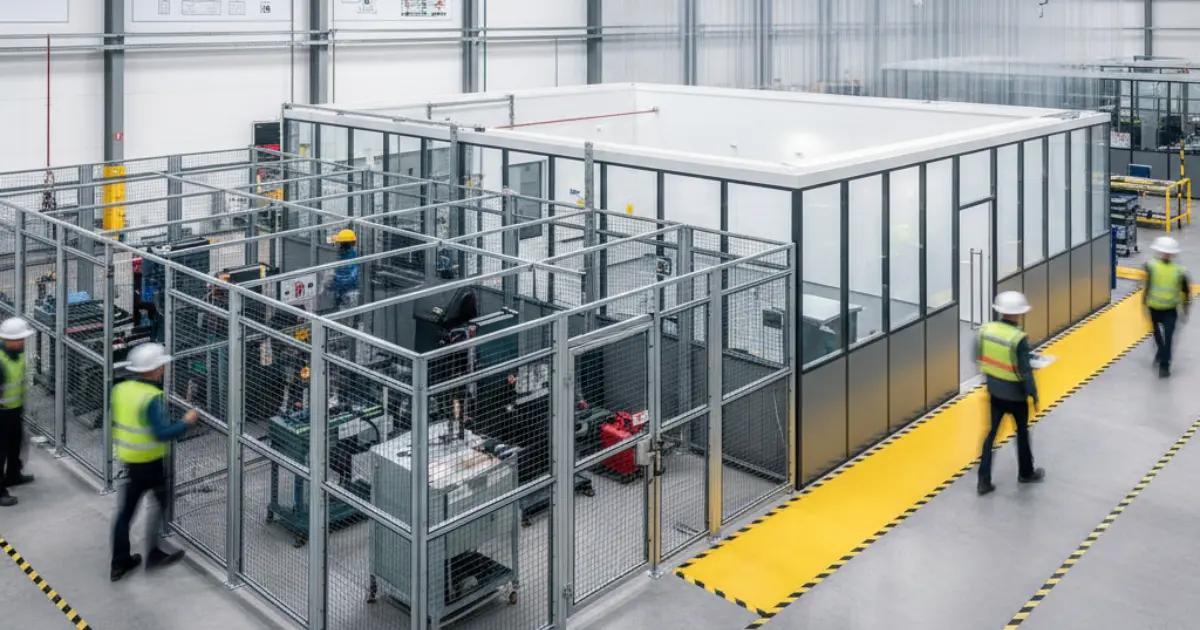
Flexible factory partitioning is revolutionizing how industrial facilities approach workspace design, offering manufacturers and warehouse operators the ability to reconfigure their floor plans without the permanent commitment and substantial costs of traditional construction. In today’s rapidly evolving manufacturing landscape—particularly in automotive production where lean principles and just-in-time processes demand adaptability—the ability to quickly reorganize production areas, create temporary clean rooms, or establish dedicated quality control zones has become a competitive necessity. Unlike conventional permanent walls that require demolition and reconstruction for layout changes, flexible factory partitioning systems provide modular, relocatable solutions that transform industrial workspaces in days rather than months, minimizing operational disruption while maximizing spatial efficiency.
The shift toward flexible partitioning solutions represents more than just a trend—it reflects fundamental changes in manufacturing philosophy. Modern factories must accommodate varying production volumes, support multiple product lines simultaneously, and adapt to new equipment installations without extensive downtime. For facility managers and operations directors evaluating workspace optimization strategies, understanding the full spectrum of flexible factory partitioning options, their implementation requirements, and long-term value proposition is essential for making informed investment decisions that align with both current operational needs and future growth trajectories.
What is flexible factory partitioning?
Flexible factory partitioning encompasses a range of modular partition walls and industrial partition systems designed specifically for the demanding environments of manufacturing facilities, warehouses, and industrial complexes. Unlike residential room dividers or standard office partitions, these industrial-grade solutions are engineered to withstand the rigors of factory operations—including exposure to dust, temperature fluctuations, vibration from heavy machinery, and the movement of forklifts and other material handling equipment.
At its core, flexible factory partitioning provides a semi-permanent to temporary barrier system that divides large industrial spaces into functional zones without the permanence of traditional construction. These systems typically consist of prefabricated panels, frames, and mounting hardware that can be assembled, disassembled, and reconfigured as operational requirements change. The “flexible” designation refers not only to the physical adaptability of the systems but also to their versatility in application—from creating enclosed production cells and storage areas to establishing safety zones and climate-controlled environments within larger facilities.
Modern industrial partition systems incorporate various materials and construction methods depending on their intended purpose. Steel-framed panels with powder-coated finishes offer durability and fire resistance, while polycarbonate or acrylic glazing provides visibility for supervision and quality monitoring. Some systems integrate sound-dampening materials to reduce noise transmission between production areas, while others feature insulated panels to maintain temperature differentials for specialized manufacturing processes or storage requirements.
The distinguishing characteristic that sets flexible factory partitioning apart from both permanent construction and lightweight temporary solutions is the balance between structural integrity and reconfigurability. These systems must meet industrial safety standards and building codes while maintaining the ability to be relocated or modified without specialized construction expertise. This dual requirement has driven innovation in mounting systems, panel connections, and modular design approaches that allow facilities to achieve near-permanent functionality with temporary installation methods.
Benefits of Flexible Partitioning in Industrial Spaces
The adoption of flexible factory partitioning delivers multiple strategic advantages that directly impact operational efficiency, financial performance, and workplace safety. For facility managers facing pressure to optimize space utilization while controlling capital expenditures, these benefits create a compelling business case that extends beyond simple cost savings.
Operational Agility and Adaptability stand as the primary advantage of modular factory walls. Manufacturing operations rarely remain static—product lines evolve, production volumes fluctuate, and new equipment installations necessitate layout modifications. Flexible partitioning enables facilities to respond to these changes rapidly, often reconfiguring spaces over weekends or during planned maintenance windows rather than requiring extended production shutdowns. This agility proves particularly valuable in automotive manufacturing, where model changeovers and production line rebalancing occur regularly throughout a vehicle’s lifecycle.
The cost-effectiveness of flexible partitioning compared to permanent construction represents another significant benefit. Traditional wall construction involves not only material and labor costs but also expenses related to permits, inspections, HVAC modifications, electrical work, and finishing. When layout changes become necessary, demolition costs add further financial burden. Flexible partition systems eliminate most of these expenses while providing comparable functionality for space division. The initial investment in quality industrial partition systems typically pays for itself within the first reconfiguration, with subsequent modifications delivering pure cost savings.
Minimized disruption to ongoing operations cannot be overstated as a benefit. Permanent construction projects in active manufacturing facilities create noise, dust, safety hazards, and access restrictions that impact productivity across adjacent work areas. Installation of modular partition walls typically occurs with minimal interference to surrounding operations, often requiring only temporary clearance of the immediate installation zone. This reduced disruption translates directly to maintained production output and revenue generation during facility modifications.
Flexible factory partitioning also enhances workplace safety and environmental control. Creating dedicated zones for hazardous processes, establishing controlled access areas, or separating incompatible operations becomes straightforward with modular systems. Many industrial partition systems incorporate safety features such as impact-resistant materials, visibility panels for supervision, and integration points for safety equipment like emergency stops or warning systems. The ability to quickly establish containment areas for dust, fumes, or temperature-sensitive processes improves both worker safety and product quality.
From a financial accounting perspective, flexible partitioning systems often qualify as movable equipment rather than permanent improvements to real property. This classification can provide tax advantages through accelerated depreciation schedules and may preserve flexibility in leased facilities where permanent alterations require landlord approval or revert to the property owner at lease termination. For companies operating in multiple facilities or planning future relocations, the portability of these systems represents tangible asset value.
Types of Flexible Factory Partition Systems
The market for industrial partition systems has evolved to address diverse operational requirements, resulting in several distinct categories of flexible factory partitioning solutions. Understanding these options enables facility managers to select systems optimized for their specific applications and performance criteria.
Modular Panel Systems represent the most common category of flexible factory partitioning. These systems utilize standardized panels—typically ranging from 3 to 12 feet in width and 8 to 20 feet in height—that connect through proprietary joining mechanisms. Panels may be solid, partially glazed, or fully transparent depending on visibility requirements. The modular nature allows for virtually unlimited configuration possibilities, with panels available in various materials including steel, aluminum, composite materials, and impact-resistant plastics. Many modular wall systems incorporate integrated channels for electrical conduit, compressed air lines, or data cabling, enabling complete workstation functionality within partitioned areas.
Track-Mounted Sliding Partition Walls provide maximum flexibility for spaces requiring frequent reconfiguration. These warehouse space dividers suspend from overhead track systems, allowing panels to slide horizontally to open or close spaces as needed. While more commonly associated with commercial applications like conference room dividers, industrial-grade sliding systems are engineered for factory environments with reinforced tracks, heavy-duty rollers, and panels capable of withstanding industrial conditions. This category proves particularly valuable in facilities that need to alternate between open floor plans for large equipment movement and divided spaces for production operations.
Freestanding Partition Systems offer installation flexibility without requiring ceiling or permanent floor attachments. These industrial room dividers utilize weighted bases, tension systems, or interlocking panel designs to achieve stability without permanent mounting. While generally limited to lower heights than ceiling-mounted systems, freestanding partitions excel in applications requiring frequent repositioning or in facilities where ceiling structure cannot support suspended loads. Advanced freestanding systems incorporate stabilizing features such as floor-to-panel compression mechanisms or interconnected panel arrays that distribute lateral forces across multiple units.
Industrial Partition Curtains provide the most economical and rapidly deployable option for temporary space division. Constructed from heavy-duty vinyl, reinforced fabric, or specialized materials offering thermal insulation or sound dampening, these curtain systems suspend from overhead track or cable systems. While lacking the structural rigidity and sound isolation of solid panel systems, industrial partition curtains excel in applications requiring visual separation, dust containment, or climate zone creation. Many automotive manufacturing facilities utilize curtain systems to establish paint booth enclosures, welding zones, or temperature-controlled assembly areas where rigid partitions would be impractical.
Hybrid and Specialized Systems combine elements from multiple partition categories to address unique operational requirements. Examples include systems with solid lower panels for impact protection topped with transparent upper sections for supervision, partitions incorporating integrated doors and access control, or climate-controlled enclosures with insulated panels and integrated HVAC interfaces. Some manufacturers offer customized solutions incorporating features like cleanroom-rated materials, explosion-proof construction for hazardous environments, or acoustic treatments for noise-sensitive operations.
Flexible Partitioning in Automotive Manufacturing
The automotive manufacturing sector has emerged as one of the primary adopters of automotive manufacturing partitions, driven by the industry’s unique combination of space requirements, production flexibility needs, and quality control standards. Modern automotive facilities face constant pressure to accommodate multiple vehicle platforms, support mixed-model production lines, and adapt to evolving manufacturing technologies—all within existing facility footprints.
In automotive assembly plants, flexible factory partitioning enables the creation of dedicated work cells for specific assembly operations without the commitment of permanent construction. As vehicle designs evolve and assembly sequences change, these modular factory walls can be relocated to optimize workflow and material flow. For example, when introducing a new vehicle platform that requires additional pre-assembly operations, manufacturers can quickly establish enclosed work cells using partition systems, complete with integrated lighting, power distribution, and material presentation systems. When that platform reaches end-of-life, the partitions relocate to support the next program rather than becoming obsolete infrastructure.
Quality control and inspection areas in automotive facilities particularly benefit from flexible partitioning solutions. These zones require controlled lighting, reduced contamination from surrounding operations, and often climate control to ensure measurement accuracy. Modular partition walls with integrated lighting systems and optional HVAC interfaces create inspection environments that meet stringent quality standards while remaining adaptable as inspection requirements evolve with new vehicle technologies and measurement systems.
Paint and coating operations represent another critical application for automotive manufacturing partitions. While permanent paint booths handle primary body coating, many facilities require flexible containment for sub-assembly painting, touch-up operations, or specialized coating processes. Industrial partition curtains combined with ventilation systems create compliant spray environments that can be established, modified, or removed as production requirements change. This flexibility proves essential as automotive manufacturers increasingly incorporate mixed materials requiring different coating processes and cure cycles.
The rise of electric vehicle production has created new partitioning requirements in automotive facilities. Battery assembly and testing operations demand controlled environments with specific temperature ranges, humidity levels, and contamination controls. Flexible factory partitioning systems with insulated panels and environmental seals enable manufacturers to establish these specialized zones within existing facilities, often converting areas previously used for conventional powertrain assembly. The modular nature of these systems accommodates the rapid evolution of battery technologies and assembly processes without requiring permanent facility modifications.
Lean manufacturing principles widely adopted in automotive production align naturally with flexible partitioning approaches. Creating visual management systems, establishing kanban zones, and implementing cellular manufacturing all benefit from the ability to define and redefine workspace boundaries quickly. Transparent partition panels support visual factory concepts by maintaining sightlines for supervision and workflow monitoring while providing necessary separation between operations. As continuous improvement initiatives identify optimization opportunities, partition systems can be reconfigured to support new layouts without the resistance associated with permanent construction projects.
Safety Standards and Compliance Requirements
Implementing flexible factory partitioning in industrial environments requires careful attention to safety standards, building codes, and industry-specific regulations. While the temporary or semi-permanent nature of these systems might suggest relaxed requirements, responsible installation demands compliance with the same fundamental safety principles governing permanent construction.
Building code compliance represents the foundation of safe partition installation. Even temporary partition walls must meet local building codes regarding fire resistance, structural stability, and emergency egress. Most jurisdictions classify partitions based on height, permanence, and whether they create enclosed spaces—with different requirements for each classification. Facility managers must work with partition suppliers and local building officials to determine applicable requirements, which may include fire ratings for panel materials, structural calculations for seismic zones, and emergency exit provisions for enclosed areas.
Fire safety considerations are paramount in industrial settings where flammable materials, hot work, and ignition sources are present. Industrial partition systems should incorporate non-combustible or fire-rated materials appropriate to the facility’s occupancy classification and the specific operations occurring in partitioned areas. Many modular wall systems offer panels with certified fire resistance ratings, allowing facilities to maintain required fire separations without permanent construction. Additionally, partition layouts must preserve required exit access, maintain exit signage visibility, and avoid creating dead-end corridors that could trap occupants during emergencies.
Structural stability and seismic requirements ensure partitions remain secure during normal operations and emergency conditions. Industrial environments subject partitions to vibration from machinery, air pressure differentials from ventilation systems, and potential impacts from material handling equipment. Proper installation requires adequate anchoring to floor, ceiling, or both depending on partition height and local seismic requirements. In earthquake-prone regions, partition systems must either flex to accommodate building movement or incorporate seismic bracing to prevent collapse. Manufacturers typically provide engineering specifications and installation guidelines to ensure structural adequacy when systems are properly installed.
Industry-specific regulations add additional compliance layers in automotive manufacturing and other regulated sectors. OSHA requirements for machine guarding, hazardous energy control, and process safety may dictate partition specifications for areas containing automated equipment or hazardous operations. For example, partitions separating robotic work cells must prevent unauthorized access while maintaining visibility for supervision and emergency response. Facilities handling hazardous materials may require partitions with specific chemical resistance or ventilation integration to maintain required containment.
Environmental compliance considerations include noise control, air quality management, and waste containment. Many jurisdictions regulate industrial noise levels at property boundaries, making sound-dampening partition systems valuable for compliance. Similarly, operations generating dust, fumes, or other air contaminants may require partitions integrated with ventilation systems to maintain air quality standards. Facilities must ensure partition installations don’t compromise existing environmental control systems or create new compliance challenges.
Accessibility requirements under the Americans with Disabilities Act (ADA) and similar regulations worldwide apply to partition installations that create rooms, corridors, or workspaces. Door widths, maneuvering clearances, and accessible routes must be maintained when installing modular office walls with doors or creating enclosed spaces. Even temporary installations must provide equal access to all facility areas unless specific exemptions apply.
Cost Comparison: Flexible Partitions vs. Permanent Walls
The financial decision between flexible factory partitioning and traditional permanent construction involves analyzing both immediate costs and long-term value across the expected lifecycle of the facility layout. While initial price comparisons may seem straightforward, comprehensive cost analysis reveals significant differences in total cost of ownership.
Initial installation costs for flexible partition systems typically range from $30 to $150 per linear foot depending on system type, height, materials, and features. Basic industrial partition curtains represent the lower end of this range, while sophisticated modular wall systems with integrated doors, windows, and services approach the higher end. In contrast, permanent wall construction in industrial facilities typically costs $75 to $300+ per linear foot when accounting for materials, labor, permits, inspections, finishing, and integration with building systems like HVAC and fire suppression.
However, these initial cost figures don’t tell the complete story. Permanent construction requires additional expenses often overlooked in preliminary budgets: engineering and architectural services, permit fees, inspection costs, temporary production disruption, and extended project timelines that delay the operational benefits of the layout change. Flexible factory partitioning eliminates or significantly reduces most of these ancillary costs. Installation typically occurs in days rather than weeks or months, often during scheduled maintenance windows with minimal production impact. Many systems require no permits beyond standard facility modification notifications, and installation can be performed by facility maintenance staff or partition suppliers without specialized contractors.
Reconfiguration costs dramatically favor flexible systems. When operational requirements change—an inevitability in dynamic manufacturing environments—permanent walls require demolition and reconstruction. Demolition costs alone often equal or exceed original construction costs when accounting for debris removal, environmental remediation (particularly for older facilities with asbestos or lead paint), and restoration of adjacent areas. Building new walls in different locations then incurs full construction costs again. In contrast, relocating modular partition walls typically costs 20-40% of initial installation, primarily involving labor to disassemble, move, and reassemble panels. Some systems achieve even lower reconfiguration costs through design features enabling single-person panel removal and reinstallation.
The opportunity cost of production disruption represents a critical but often unquantified expense. Permanent construction projects in active manufacturing facilities create noise, dust, safety hazards, and access restrictions affecting productivity across substantial areas. A construction project requiring two weeks of reduced capacity in a production zone generating $50,000 daily revenue creates $700,000 in opportunity cost—far exceeding the cost difference between permanent and flexible partitioning. Flexible systems minimize this disruption, often enabling installation during off-shifts or weekends with zero production impact.
From a lifecycle cost perspective, flexible factory partitioning delivers superior value in facilities expecting multiple layout changes. Consider a facility anticipating three major reconfigurations over a 15-year period. Permanent construction might cost $200,000 initially plus $300,000 for two demolition-and-rebuild cycles (total: $500,000). A flexible system costing $150,000 initially plus $50,000 for two reconfigurations totals $250,000—a 50% savings before accounting for reduced disruption and faster implementation enabling earlier realization of operational benefits.
Tax and accounting implications add another dimension to cost analysis. Permanent improvements to real property typically depreciate over 39 years under U.S. tax law, while movable partition systems may qualify for shorter depreciation periods as equipment. This accelerated depreciation provides earlier tax benefits and improved cash flow. Additionally, in leased facilities, permanent improvements may revert to the landlord at lease termination, representing a total loss of investment, while portable partition systems retain value as relocatable assets.
For facilities seeking warehouse partition wall cheap solutions, it’s essential to distinguish between low initial cost and low total cost of ownership. Inexpensive systems using lightweight materials and simplified mounting may require frequent repairs, offer limited reconfiguration options, or fail to meet safety and compliance requirements—ultimately costing more through replacement needs and operational limitations. Quality industrial partition systems from reputable manufacturers provide decades of service across multiple reconfigurations, delivering superior long-term value despite higher initial investment.
Installation Process and Timeline
Understanding the installation process for flexible factory partitioning helps facility managers plan implementations that minimize operational disruption while ensuring proper system performance and compliance. While specific procedures vary by system type, most installations follow a common sequence that can be completed in significantly less time than permanent construction.
Pre-installation planning and site assessment begins the process, typically requiring one to two weeks depending on project complexity. This phase includes measuring the installation area, evaluating floor and ceiling conditions, identifying utilities and obstructions, and developing a detailed layout plan. For facilities with existing operations, planning must address material staging areas, equipment access requirements, and coordination with production schedules. Many partition suppliers provide site assessment services, using facility measurements and operational requirements to develop optimized partition configurations and identify potential installation challenges before equipment arrives.
During planning, facilities must also address compliance requirements including building permits (if required), fire marshal approvals for layouts affecting egress or fire protection systems, and internal safety reviews. While flexible systems typically face fewer regulatory hurdles than permanent construction, responsible implementation ensures all applicable requirements are identified and addressed. This planning investment prevents costly mid-installation discoveries that could delay completion or require design modifications.
Material procurement and delivery timelines vary based on system type and customization requirements. Standard modular partition walls using stock panel sizes and configurations may ship within days of order placement, while customized systems incorporating specific dimensions, specialized materials, or integrated features like doors and windows typically require 2-6 weeks for fabrication. Facilities should coordinate delivery timing with installation schedules, ensuring adequate staging space for materials without disrupting ongoing operations. Many suppliers offer just-in-time delivery services, sequencing material arrival to match installation progress and minimize on-site storage requirements.
Site preparation immediately precedes installation, typically requiring one to two days for most projects. Preparation includes clearing the installation area of equipment and materials, protecting adjacent operations from installation activities, and establishing safety barriers and signage. For ceiling-mounted systems, site preparation may include installing support structures or verifying existing ceiling capacity. Floor-mounted systems may require surface preparation to ensure proper anchor installation and partition stability. Thorough site preparation prevents installation delays and quality issues while maintaining safety for both installation crews and facility personnel.
Physical installation of flexible factory partitioning systems typically occurs in three to ten days for most industrial applications, though large or complex projects may extend this timeline. Installation begins with establishing the partition framework—mounting floor tracks, ceiling supports, or freestanding bases depending on system type. Crews then install panels sequentially, making connections between panels and to the mounting system. For modular wall systems with integrated doors, windows, or service penetrations, installation includes fitting and adjusting these components to ensure proper operation and sealing.
The speed advantage of flexible systems becomes apparent during this phase. A partition run requiring two weeks for permanent construction—including framing, drywall installation, taping, finishing, and painting—can often be completed with modular panels in two to three days. Industrial partition curtains install even faster, with some systems achieving complete installation in a single shift. This compressed timeline minimizes production disruption and accelerates the operational benefits of the layout change.
System integration and testing follows physical installation, addressing electrical connections, HVAC interfaces, and any specialized features like access control or environmental monitoring. While simpler than integration requirements for permanent construction, this phase ensures partitioned areas function as intended. Testing includes verifying door operation, checking environmental seals, confirming proper ventilation in enclosed spaces, and validating any integrated safety systems. For automotive manufacturing partitions and other applications with specific environmental requirements, testing may include temperature verification, air quality monitoring, or noise level measurements.
Final inspection and commissioning completes the installation process, typically requiring one day. This phase includes final adjustments to ensure proper fit and function, cleaning installation areas, removing staging materials and equipment, and conducting walk-throughs with facility management to verify the installation meets requirements. Any required regulatory inspections occur during this phase, though flexible systems typically face fewer inspection requirements than permanent construction. Upon completion, suppliers often provide operation and maintenance training for facility staff, ensuring long-term system performance.
For facilities requiring minimal disruption to ongoing operations, many installation projects can be scheduled during off-shifts, weekends, or planned maintenance windows. Modular systems’ rapid installation enables complete implementation during a single weekend shutdown, with production resuming Monday morning in a reconfigured facility. This capability provides enormous value in high-volume manufacturing environments where every hour of production downtime carries significant financial impact.
Real-World Case Studies: Automotive Facilities
Examining real-world implementations of flexible factory partitioning in automotive manufacturing environments illustrates the practical benefits and return on investment these systems deliver. While specific company names are often confidential, these representative cases demonstrate common applications and outcomes.
Case Study 1: Assembly Line Reconfiguration for Model Changeover
A Tier 1 automotive supplier producing instrument panels faced a challenge when their primary customer introduced a new vehicle platform requiring significantly different assembly processes. The existing facility layout optimized for the outgoing model needed substantial reconfiguration to accommodate new equipment and workflow. Traditional construction estimates projected 8-12 weeks and $450,000 for demolition of existing walls and construction of new permanent partitions in the revised layout.
Instead, the facility implemented a modular partition wall system, creating new work cells and material flow paths aligned with the new assembly process. The installation occurred over two weekends during planned production shutdowns, with total project costs of $180,000 including partition materials, installation labor, and integration with existing utilities. The compressed timeline enabled production startup three weeks earlier than the permanent construction approach would have allowed, generating approximately $1.2 million in additional revenue during that period. When the vehicle platform eventually reaches end-of-life, the partitions will be reconfigured to support the next program rather than demolished as waste.
Case Study 2: Quality Control Environment Creation
An automotive electronics manufacturer needed to establish a controlled environment for final inspection and testing of safety-critical components. The inspection process required stable temperature and humidity, controlled lighting, and isolation from contamination sources in the surrounding production area. Permanent cleanroom construction was estimated at $320,000 with a 10-week timeline.
The facility selected insulated modular factory walls with integrated HVAC interfaces and LED lighting systems. Installation occurred in 12 days with a total investment of $145,000. The controlled environment achieved required specifications for temperature stability (±2°F) and particulate control (Class 100,000 cleanroom equivalent). Beyond cost savings, the modular approach provided flexibility to expand the inspection area when production volumes increased 18 months later—accomplished over a single weekend at 25% of the cost of expanding a permanent cleanroom.
Case Study 3: Paint Process Containment
A custom automotive fabricator performing specialized coating operations needed compliant spray booth environments for multiple small-batch processes. Permanent booth construction for three separate coating areas was quoted at $280,000. The facility instead implemented industrial partition curtains with integrated ventilation, creating flexible spray environments at a total cost of $65,000. The curtain systems provided required containment and ventilation while enabling rapid reconfiguration as job mix changed. When certain coating processes were discontinued and new ones introduced, the curtain systems were simply repositioned—a modification that would have required demolition and reconstruction with permanent booths.
Case Study 4: Mixed-Model Production Line Flexibility
An automotive assembly plant producing multiple vehicle variants on a single line needed to create temporary sub-assembly areas for specific models without disrupting production of other variants. The challenge involved establishing and removing work cells on weekly cycles as production schedules changed. Permanent construction was impractical given the frequency of changes.
The facility deployed a combination of freestanding partition systems and track-mounted sliding panels, creating a library of portable work cell configurations. Production planners could specify required layouts, and maintenance crews could reconfigure the line during shift changes or weekend periods. The $220,000 investment in flexible partitioning systems enabled production flexibility valued at over $3 million annually through improved schedule adherence and reduced changeover times. The system has been in continuous use for six years across hundreds of reconfigurations—an application impossible with permanent construction.
Case Study 5: Electric Vehicle Battery Assembly
An automotive manufacturer converting a portion of an existing engine plant to electric vehicle battery pack assembly needed to create a controlled environment meeting stringent contamination and safety requirements. The conversion timeline was aggressive, with production startup required in four months. Permanent construction could not meet this deadline.
The facility implemented a comprehensive flexible factory partitioning solution incorporating insulated panels for temperature control, transparent sections for supervision, integrated safety systems, and specialized flooring. The modular approach enabled parallel workflows—partition installation proceeded while equipment was being installed and commissioned in adjacent areas. Total installation time was 18 days, enabling the facility to meet its production startup deadline. The modular construction cost $385,000 compared to $620,000 for permanent construction, with the added benefit of reconfigurability as battery technologies and assembly processes evolve.
Choosing the Right Partition System for Your Factory
Selecting the optimal flexible factory partitioning solution requires evaluating multiple factors specific to your facility’s operational requirements, physical constraints, and long-term plans. A systematic selection process ensures the chosen system delivers required functionality while providing maximum value and flexibility.
Operational requirements should drive the selection process. Begin by clearly defining what the partition system must accomplish: Is the primary need visual separation, sound isolation, environmental control, safety containment, or some combination? Different partition types excel at different functions. Industrial partition curtains provide excellent visual separation and basic environmental containment at minimal cost but offer limited sound isolation. Solid panel systems deliver superior acoustic performance and environmental control but at higher cost and with less flexibility for frequent reconfiguration. Transparent or partially glazed systems support supervision and visual management while providing physical separation.
Consider the frequency of reconfiguration anticipated over the system’s lifecycle. Facilities expecting weekly or monthly layout changes benefit from highly modular systems with tool-free panel connections and minimal anchoring requirements. Operations planning one or two reconfigurations over several years can justify more robust systems with permanent mounting that provide enhanced performance characteristics. Track-mounted sliding systems excel when spaces need to alternate between open and divided configurations on daily or weekly cycles.
Environmental control requirements significantly influence system selection. Partitioned areas requiring temperature control, humidity management, or contamination isolation need insulated panels with effective sealing systems. The level of control required—from basic temperature stability to cleanroom-grade environmental management—determines panel construction, sealing methods, and integration requirements with HVAC systems. Automotive manufacturing partitions for paint processes, for example, require different environmental performance than partitions creating assembly work cells.
Safety and compliance considerations establish minimum performance standards the partition system must meet. Fire resistance ratings, structural capacity, impact resistance, and emergency egress provisions are non-negotiable requirements determined by building codes and operational hazards. Systems must also support specific safety needs like machine guarding, hazardous material containment, or explosion protection depending on the processes occurring in partitioned areas. Verify that candidate systems have appropriate certifications and testing documentation for your application.
Physical constraints of your facility may limit partition options. Ceiling height and structure determine whether ceiling-mounted systems are feasible and what panel heights are practical. Floor conditions affect anchoring methods and may favor freestanding systems in areas where floor penetrations are problematic. Existing building systems—lighting, sprinklers, HVAC—influence partition placement and may require systems with integrated service channels or transparent panels to maintain required clearances and functionality.
Acoustic performance requirements vary widely across industrial applications. Some operations need minimal sound isolation—just enough to reduce distraction and support communication within work areas. Others require substantial noise reduction to meet regulatory limits, protect hearing, or enable precision work requiring concentration. Partition systems offer Sound Transmission Class (STC) ratings ranging from STC 20 for basic curtain systems to STC 50+ for specialized acoustic panels. Match system acoustic performance to your specific requirements, as higher performance typically commands premium pricing.
Integration requirements for doors, windows, utilities, and equipment affect system selection and cost. Facilities needing frequent access through partitioned areas require systems accommodating various door types—from simple hinged doors to overhead doors for equipment movement. Power, compressed air, data, and other utilities may need to pass through or integrate with partition systems, requiring systems with service channels or penetration provisions. Consider both current integration needs and likely future requirements to avoid selecting systems that limit operational flexibility.
Aesthetic considerations, while often secondary in industrial environments, can influence system selection particularly in areas visible to customers or in facilities emphasizing visual management and workplace organization. Panel finishes, colors, and transparency options allow partition systems to support facility branding and visual communication strategies while fulfilling functional requirements. Some manufacturers offer custom colors and finishes to match corporate standards or support color-coded zone identification.
Supplier capabilities and support deserve careful evaluation. The best partition system poorly installed delivers disappointing results, while a good system properly implemented by knowledgeable suppliers provides years of reliable service. Evaluate suppliers based on industrial experience, installation capabilities, engineering support for custom applications, and post-installation service. Suppliers offering comprehensive services—from initial consultation and layout design through installation, training, and ongoing support—typically deliver superior outcomes compared to product-only vendors.
Total cost of ownership rather than initial price should guide final selection. Calculate costs across the expected system lifecycle including initial purchase, installation, anticipated reconfigurations, maintenance, and eventual replacement or disposal. Factor in the value of operational flexibility, reduced disruption during installation and reconfiguration, and potential tax benefits. A system with 30% higher initial cost but 50% lower reconfiguration costs and twice the service life delivers superior value for facilities expecting multiple layout changes.
Maintenance and Long-Term Durability
Maximizing the service life and performance of flexible factory partitioning systems requires appropriate maintenance practices and realistic expectations regarding durability in demanding industrial environments. Well-maintained systems routinely provide 15-25 years of service across multiple reconfigurations, while neglected systems may require replacement or extensive repairs within 5-10 years.
Routine maintenance requirements for most industrial partition systems are minimal but essential. Regular cleaning prevents accumulation of industrial dust, oils, and contaminants that can degrade panel finishes and sealing systems. Cleaning frequency depends on environmental conditions—facilities with significant airborne particulates may require monthly cleaning, while cleaner environments may need only quarterly attention. Use appropriate cleaning methods for panel materials: mild detergent solutions for painted steel panels, specialized cleaners for polycarbonate glazing to prevent scratching, and manufacturer-recommended products for specialized finishes.
Inspect panel connections and mounting systems quarterly, checking for loosening of fasteners, wear on connection hardware, and proper alignment. Industrial environments subject partitions to vibration, temperature cycling, and occasional impacts that can gradually loosen connections. Tightening fasteners and adjusting alignments during routine inspections prevents minor issues from developing into structural problems. Pay particular attention to floor-mounted tracks and ceiling supports, ensuring anchors remain secure and structural members show no signs of fatigue or damage.
Sealing systems require periodic inspection and replacement to maintain environmental control performance. Gaskets, weatherstripping, and door seals compress over time and exposure to temperature extremes, reducing their effectiveness. Annual inspection of sealing systems identifies areas needing replacement before environmental control degrades noticeably. Maintaining effective seals preserves energy efficiency in climate-controlled partitioned areas and ensures continued compliance with environmental requirements for processes requiring contamination control.
Door and hardware maintenance follows standard practices for industrial doors. Lubricate hinges, latches, and closing mechanisms according to manufacturer recommendations—typically quarterly for high-use doors. Adjust door closers and latches to ensure proper operation and secure closure. Replace worn or damaged hardware promptly, as malfunctioning doors compromise both security and environmental control. For systems with integrated access control or safety interlocks, verify proper operation during routine maintenance and address any issues immediately to maintain safety system integrity.
Damage repair should occur promptly to prevent minor damage from propagating and to maintain system appearance and function. Industrial environments inevitably subject partitions to impacts from forklifts, material handling equipment, and process equipment. Most modular partition walls allow individual panel replacement without disturbing adjacent panels—a significant advantage over permanent construction where wall damage often requires extensive repairs. Maintain an inventory of spare panels in commonly damaged areas, enabling immediate replacement and minimizing visual impact of damage.
Long-term durability of flexible factory partitioning depends heavily on initial system quality and appropriateness for the application. Industrial-grade systems from reputable manufacturers using quality materials and robust construction methods routinely provide decades of service. Key durability factors include:
- Panel material quality: Powder-coated steel panels resist corrosion and maintain appearance far better than painted panels. Aluminum frames resist corrosion in humid environments. Impact-resistant glazing materials prevent crack propagation from minor impacts.
- Connection system design: Robust mechanical connections outlast adhesive or friction-based systems, particularly in environments with vibration or temperature cycling. Systems allowing repeated assembly and disassembly without degrading connection integrity support multiple reconfigurations.
- Finish durability: High-quality powder coating, anodizing, or other protective finishes maintain appearance and prevent corrosion despite exposure to industrial environments. Inferior finishes may show wear, fading, or corrosion within a few years.
- Structural design: Adequate panel thickness, reinforcement, and frame strength ensure partitions maintain integrity despite normal industrial impacts and stresses. Under-designed systems may show warping, sagging, or structural failure within years.
Documentation and record-keeping support effective long-term maintenance. Maintain records of installation dates, configuration changes, maintenance activities, and repairs. This documentation helps identify recurring issues, plan preventive maintenance, and make informed decisions about system modifications or replacements. For facilities with multiple partition installations, centralized documentation enables consistent maintenance practices and efficient spare parts management.
Supplier relationships contribute to long-term system performance. Establish ongoing relationships with partition suppliers for technical support, replacement parts, and reconfiguration services. Many suppliers offer maintenance contracts providing scheduled inspections, preventive maintenance, and priority service for repairs. These relationships prove particularly valuable when system modifications or expansions are needed, ensuring new components integrate seamlessly with existing installations.
Consider system upgrades and modernization as partitions age. Even well-maintained systems may benefit from component upgrades as technologies improve. LED lighting retrofits, improved sealing systems, or enhanced door hardware can extend system life and improve performance without complete replacement. Evaluate upgrade opportunities during major reconfigurations when panels are already being relocated, minimizing installation labor costs.
The end-of-life decision for flexible factory partitioning systems should consider both physical condition and functional obsolescence. Systems may remain structurally sound but no longer meet operational requirements due to changed processes, updated safety standards, or facility modernization. In such cases, systems may find continued use in less demanding applications, be sold to other facilities, or be recycled. The modular nature of quality partition systems preserves residual value even at end-of-life—a stark contrast to permanent construction that becomes waste upon demolition.
In conclusion, flexible factory partitioning represents a strategic investment in operational agility for modern manufacturing facilities. By understanding the full spectrum of available systems, their capabilities and limitations, and the requirements for successful implementation and maintenance, facility managers can make informed decisions that optimize both immediate functionality and long-term value. As manufacturing continues evolving toward greater flexibility and responsiveness, the ability to rapidly reconfigure physical workspaces without the constraints of permanent construction will increasingly separate competitive facilities from those struggling to adapt. Whether addressing immediate layout challenges or building long-term operational flexibility, flexible factory partitioning delivers proven solutions that transform industrial workspaces while preserving capital and minimizing disruption.
Frequently Asked Questions
What is flexible factory partitioning?
Flexible factory partitioning refers to modular, movable wall systems designed to divide industrial spaces without permanent construction. These partitions allow manufacturers and warehouse operators to reconfigure their floor plans quickly as production needs change, offering a cost-effective alternative to traditional fixed walls. Common types include modular panels, industrial curtains, and sliding partition systems that can be installed, relocated, or removed with minimal disruption to operations.
How much does flexible factory partitioning cost?
The cost of flexible factory partitioning typically ranges from $15 to $75 per square foot, depending on the materials, height, and features required. Industrial curtain partitions are generally the most affordable option at $15-30 per square foot, while heavy-duty modular wall systems with soundproofing or climate control features can cost $50-75 per square foot. Despite the initial investment, flexible partitioning systems cost 40-60% less than traditional construction and can be reused multiple times, providing significant long-term savings.
What are the main types of factory partitions?
The two primary types of factory partitions are permanent and flexible systems. Permanent partitions include traditional drywall, concrete block, or steel-framed walls that provide maximum durability and sound isolation but cannot be moved. Flexible factory partitioning systems include modular panels, industrial curtain walls, accordion-style partitions, and track-mounted sliding walls that can be reconfigured as production needs evolve.
How do you divide warehouse space effectively?
To divide warehouse space effectively, start by analyzing your workflow patterns, safety requirements, and future scalability needs. Flexible factory partitioning solutions like modular walls or industrial curtains allow you to create designated zones for receiving, storage, assembly, and shipping without permanent construction. Consider factors such as forklift traffic patterns, climate control requirements, noise reduction needs, and the frequency of layout changes when selecting your partition system.
What are the benefits of flexible partitioning in manufacturing?
Flexible partitioning in manufacturing provides rapid reconfiguration capabilities, allowing facilities to adapt to new product lines, seasonal demands, or lean manufacturing initiatives within days rather than weeks. These systems reduce construction costs by 40-60%, minimize production downtime during installation, and can be relocated or expanded as business needs change. Additional benefits include improved safety through designated work zones, better climate control for specific areas, and enhanced dust or noise containment without permanent structural modifications.
How long does it take to install flexible factory partitioning?
Installation of flexible factory partitioning typically takes 1-5 days depending on the system type and project size, compared to 2-6 weeks for traditional construction. Industrial curtain systems can often be installed in a single day, while modular panel systems may require 2-3 days for larger installations. Because these systems don’t require concrete work, extensive framing, or lengthy curing times, manufacturers can reconfigure their spaces with minimal disruption to ongoing operations.
Can flexible partitions provide soundproofing and climate control?
Yes, many flexible factory partitioning systems offer excellent soundproofing and climate control capabilities when properly specified. Modular partition walls with insulated cores can achieve sound reduction ratings of 30-45 STC (Sound Transmission Class), suitable for isolating noisy equipment. Heavy-duty industrial curtains with thermal backing can create climate-controlled zones, reducing heating and cooling costs by up to 50% in designated areas while maintaining the flexibility to reconfigure as needed.
Are flexible factory partitions suitable for cleanroom or food-grade environments?
Absolutely—specialized flexible factory partitioning systems are available for cleanroom, food processing, and pharmaceutical manufacturing environments. These partitions feature smooth, non-porous surfaces made from materials like PVC, vinyl, or powder-coated aluminum that meet FDA and ISO cleanroom standards. They can be easily cleaned and sanitized while still providing the reconfiguration benefits of flexible partitioning, making them ideal for facilities that must maintain strict hygiene standards while adapting to changing production requirements.
What industries benefit most from flexible factory partitioning?
Automotive manufacturing, warehousing and logistics, food processing, aerospace, and contract manufacturing benefit most from flexible factory partitioning due to their frequently changing production requirements. These industries often implement lean manufacturing principles, handle multiple product lines, or experience seasonal demand fluctuations that require rapid workspace reconfiguration. E-commerce fulfillment centers also increasingly rely on flexible partitioning to adapt their facilities as inventory and order processing needs evolve.
You May Also Like

DIY Projects with License Plates: 25+ Creative Ideas
KTM 1390 Super Duke R Price in India 2025: ₹18-20 Lakh Expected

Car Battery Draining Fast: 5 Common Causes & How to Fix