Principles and Practices of Commercial Construction Review

Understanding commercial construction principles is essential for anyone involved in building projects that go beyond single-family homes. Whether you’re a construction management student, an aspiring project manager, or a professional looking to transition from residential to commercial work, mastering the fundamental principles and practices of commercial construction can dramatically accelerate your career trajectory. This comprehensive guide breaks down everything you need to know about commercial construction fundamentals, including the industry-standard reference materials, practical applications, and free downloadable resources that will help you implement these concepts immediately on real-world projects.
What is Commercial Construction? (Definition & Scope)
Commercial construction refers to the building and renovation of structures used for business, retail, institutional, or industrial purposes rather than private residential living. This broad category encompasses everything from office buildings, retail stores, and restaurants to hospitals, schools, warehouses, and manufacturing facilities. Unlike residential construction, which focuses on single-family homes or small multi-family dwellings, commercial projects typically involve larger budgets, more complex building systems, stricter regulatory requirements, and multiple stakeholder coordination.
The scope of commercial construction extends across several distinct sectors. Retail construction includes shopping centers, standalone stores, and mixed-use developments. Office construction ranges from small professional buildings to high-rise corporate headquarters. Institutional construction covers schools, hospitals, government buildings, and religious facilities. Industrial construction involves manufacturing plants, warehouses, and distribution centers. Each sector has unique requirements, but all share common commercial construction principles that govern planning, design, execution, and completion.
Commercial projects also differ significantly in their procurement methods, contract structures, and delivery systems. Design-bid-build, design-build, construction management at-risk, and integrated project delivery are all common approaches in commercial work. Understanding these delivery methods is fundamental to grasping how commercial construction practices differ from residential approaches, where simpler contract structures typically prevail.
Overview: Principles and Practices of Commercial Construction
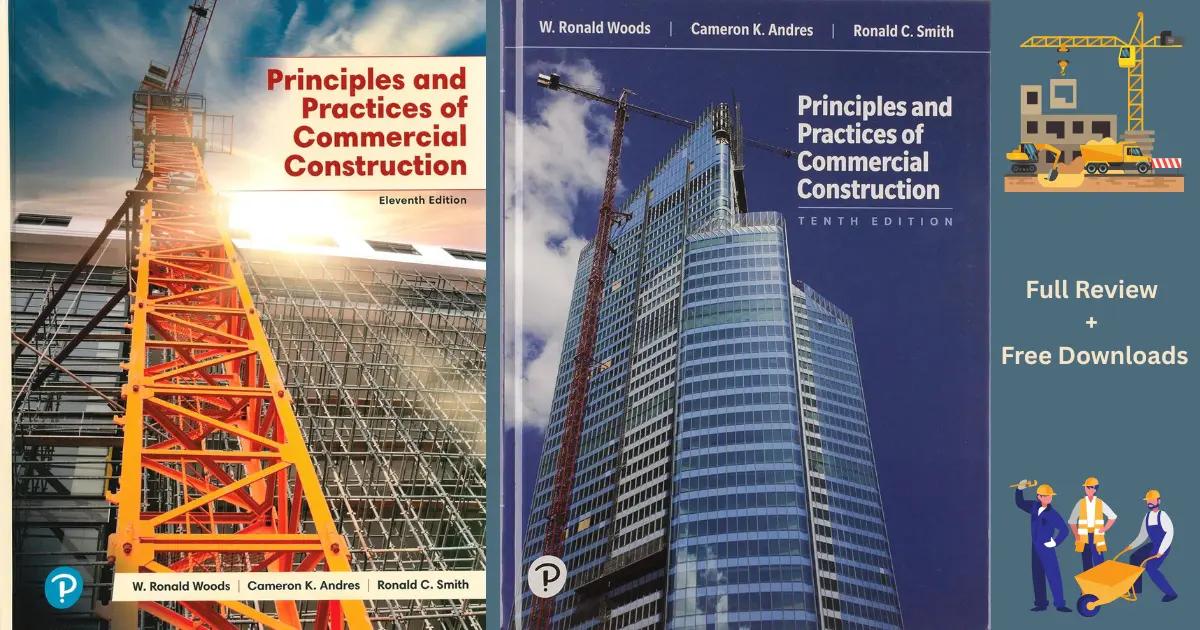
The textbook “Principles and Practices of Commercial Construction” has served as the definitive educational resource for construction management programs across North America for decades. Currently in its 11th edition as of 2024, this comprehensive reference work covers the entire lifecycle of commercial building projects, from initial concept and site selection through design development, construction execution, and project closeout. The book is authored by industry experts who combine academic rigor with practical field experience, making it equally valuable for students and practicing professionals.
The 11th edition of Principles and Practices of Commercial Construction includes updated content reflecting current industry standards, building codes, sustainability practices, and technological innovations. New sections address Building Information Modeling (BIM), lean construction methodologies, integrated project delivery systems, and advanced sustainability certifications like LEED v4.1 and the Living Building Challenge. The text also incorporates lessons learned from recent large-scale projects and addresses emerging challenges such as supply chain management, labor shortages, and the integration of prefabrication and modular construction techniques.
What distinguishes this resource from generic construction textbooks is its laser focus on the unique aspects of commercial work. The authors systematically address the complexity factors that separate commercial from residential construction: multi-story structural systems, sophisticated mechanical and electrical systems, fire protection and life safety requirements, accessibility compliance, and the coordination of multiple prime contractors and specialized subcontractors. Each chapter builds upon previous concepts, creating a logical progression that mirrors the actual sequence of commercial project development.
The 10th edition, still widely used in many programs, provides similar foundational content but lacks some of the more recent updates on digital construction tools and contemporary sustainability practices. For students and professionals seeking the most current information, the 11th edition represents the gold standard, though earlier editions remain valuable for their core principles, which have remained relatively consistent even as specific practices have evolved.
Key Principles Covered in Commercial Construction
The foundational commercial construction principles form the bedrock of successful project delivery. These principles transcend specific building types or construction methods and apply universally across the commercial sector. Understanding and applying these principles separates successful projects from troubled ones, regardless of project size or complexity.
The Five Core Principles of Construction
When professionals ask “what are the 5 principles of construction,” they’re typically referring to the fundamental concepts that govern all construction activity. First, safety stands as the paramount principle—every decision must prioritize the wellbeing of workers, future occupants, and the public. Second, quality ensures that work meets or exceeds specifications, codes, and performance standards. Third, schedule management recognizes that time is money and that coordinated sequencing prevents costly delays. Fourth, cost control maintains project financial viability through accurate estimating, budget tracking, and change order management. Fifth, communication ensures all stakeholders remain informed and aligned throughout the project lifecycle.
Project Planning and Feasibility
Commercial construction principles emphasize thorough upfront planning before breaking ground. This includes comprehensive site analysis, zoning and regulatory review, market feasibility studies, and financial pro forma development. Successful commercial builders understand that investing time in planning reduces costly changes during construction. The principle of “measure twice, cut once” applies exponentially in commercial work, where design changes during construction can trigger cascading effects across multiple trades and building systems.
Systems Integration and Coordination
Unlike residential construction, where systems are relatively simple and standardized, commercial buildings require sophisticated integration of structural, mechanical, electrical, plumbing, fire protection, and technology systems. The principle of systems thinking recognizes that these components don’t exist in isolation—changes to one system inevitably affect others. Effective coordination prevents conflicts, reduces rework, and ensures that all systems work harmoniously to create functional, efficient buildings.
Risk Management and Contingency Planning
Commercial construction principles acknowledge that uncertainty is inherent in complex projects. Effective risk management involves identifying potential problems early, quantifying their likelihood and impact, and developing mitigation strategies. This includes maintaining appropriate contingency budgets (typically 5-10% for well-defined projects), scheduling float time for critical path activities, and establishing clear protocols for addressing unforeseen conditions. The principle here is proactive rather than reactive management—anticipating problems before they occur rather than scrambling to fix them after the fact.
The 80% Rule in Construction
The 80% rule in construction refers to the principle that 80% of project value should be completed before requesting 80% of payment, ensuring that the financial relationship between owner and contractor remains balanced throughout the project. This rule protects owners from over-paying for incomplete work while ensuring contractors maintain adequate cash flow to continue operations. More broadly, the 80/20 principle (Pareto Principle) applies throughout commercial construction: 80% of delays typically stem from 20% of activities, 80% of safety incidents occur in 20% of work areas, and 80% of quality issues trace back to 20% of root causes. Understanding these concentration patterns helps project managers focus attention where it matters most.
The 3/4/5 Rule in Construction
The 3/4/5 rule in construction is a geometric principle used to establish perfect right angles without sophisticated surveying equipment. Based on the Pythagorean theorem, this rule states that a triangle with sides measuring 3, 4, and 5 units will always form a 90-degree angle. In practice, construction teams measure 3 feet along one line, 4 feet along a perpendicular line, and verify that the diagonal between these points measures exactly 5 feet. This simple technique ensures accurate building layout, particularly for establishing foundation corners, wall alignments, and structural grid lines. While modern commercial construction typically employs laser levels and total stations, the 3/4/5 rule remains valuable for quick field verifications and situations where electronic equipment isn’t available or practical.
Essential Practices Every Commercial Builder Should Know
While principles provide the philosophical foundation, commercial construction practices represent the tangible methods, techniques, and procedures that bring projects to life. These practices have evolved over decades of industry experience and represent proven approaches to common challenges.
Pre-Construction Services and Planning
Modern commercial construction practices emphasize robust pre-construction phases. This includes constructability reviews where experienced builders examine designs to identify potential construction challenges before they become field problems. Value engineering sessions systematically evaluate design alternatives to optimize cost without compromising quality or function. Detailed scheduling using Critical Path Method (CPM) analysis identifies task dependencies and determines the longest path through the project, highlighting activities that cannot be delayed without affecting the overall completion date. Comprehensive cost estimating at multiple design stages—conceptual, schematic, design development, and construction documents—ensures budget alignment and prevents costly surprises.
Procurement and Contract Management
Effective procurement practices are essential in commercial work, where material costs often represent 40-50% of total project budgets. Best practices include competitive bidding with pre-qualified subcontractors, strategic material buyouts to lock in pricing and ensure availability, and just-in-time delivery coordination to minimize on-site storage requirements. Contract management practices include clear scope definition, detailed payment schedules tied to performance milestones, and robust change order procedures that document scope changes, cost impacts, and schedule adjustments. Strong commercial builders maintain detailed records of all contract modifications, ensuring that final project costs can be reconciled against original budgets.
Quality Control and Quality Assurance
Commercial construction practices distinguish between quality control (QC) and quality assurance (QA). QC involves inspection and testing to verify that work meets specifications—concrete cylinder tests, weld inspections, waterproofing flood tests, and commissioning of mechanical systems. QA encompasses the systematic processes that prevent defects from occurring in the first place—pre-installation meetings, mock-ups, submittal reviews, and trade coordination. Leading commercial builders implement formal quality management systems that document inspection procedures, define acceptance criteria, and establish clear protocols for addressing non-conforming work.
Safety Management Systems
Commercial construction sites operate under comprehensive safety management systems that go far beyond basic OSHA compliance. Best practices include site-specific safety plans that identify hazards unique to each project, daily toolbox talks that address current work activities, regular safety audits conducted by third-party consultants, and near-miss reporting systems that capture potential incidents before they result in injuries. Leading contractors track leading indicators (safety training hours, hazard observations, near-miss reports) rather than just lagging indicators (injury rates, lost time accidents) to proactively improve safety performance.
Technology Integration and Digital Construction
Contemporary commercial construction practices increasingly rely on digital tools and technologies. Building Information Modeling (BIM) creates three-dimensional digital representations of buildings, enabling clash detection, quantity takeoffs, and construction sequencing visualization. Project management software provides real-time collaboration platforms where all stakeholders can access current drawings, specifications, submittals, and RFIs. Drones conduct site surveys and progress documentation. Laser scanning captures as-built conditions for renovation projects. Mobile devices enable field personnel to access information and report progress without returning to site offices. These technologies don’t replace fundamental construction knowledge but amplify the effectiveness of skilled professionals.
Sustainable Construction Practices
Modern commercial construction practices increasingly emphasize sustainability and environmental responsibility. This includes waste management plans that divert construction debris from landfills through recycling and salvage, indoor air quality management during construction to protect worker health and prevent contamination of finished spaces, erosion and sediment control to prevent stormwater pollution, and documentation of material sourcing to verify recycled content, regional extraction, and responsible forestry practices. Many commercial projects now pursue third-party certifications like LEED, which requires documentation of sustainable practices throughout design and construction. Energy-efficient building construction practices, particularly relevant in climate-conscious markets like Florida, incorporate enhanced insulation, high-performance glazing, efficient HVAC systems, and renewable energy integration.
Commercial vs Residential Construction: Critical Differences
Understanding the distinctions between commercial vs residential construction is crucial for professionals transitioning between sectors or students deciding where to focus their careers. While both involve creating buildings, the differences extend far beyond project scale.
Regulatory and Code Requirements
Commercial projects face significantly more stringent regulatory oversight than residential work. Building codes classify structures by occupancy type and construction type, with commercial buildings typically requiring higher fire resistance ratings, more robust structural systems, and enhanced accessibility features. Commercial projects must comply with the International Building Code (IBC) rather than the simpler International Residential Code (IRC). Permitting processes are more complex, often requiring multiple reviews by building, fire, health, and environmental agencies. Many jurisdictions require special inspections by independent testing agencies for critical elements like structural steel, concrete, and fire protection systems—requirements rarely imposed on residential projects.
Project Delivery and Contract Structures
Commercial construction employs more sophisticated project delivery methods. While residential work typically uses simple fixed-price contracts between homeowner and general contractor, commercial projects may utilize design-build delivery (single entity responsible for both design and construction), construction management at-risk (CM acts as general contractor with guaranteed maximum price), or integrated project delivery (collaborative approach with shared risk and reward). These alternative delivery methods require different skill sets and contractual relationships than traditional residential approaches.
Scale and Complexity
Commercial projects typically involve larger budgets, longer durations, and more complex building systems. A typical commercial office building might include structured parking, multiple HVAC zones with sophisticated controls, fire suppression systems, emergency power generation, elevator systems, and advanced technology infrastructure—none of which appear in standard residential construction. This complexity requires larger project teams with specialized expertise. Where a residential project might involve a general contractor and a dozen subcontractors, a major commercial project could coordinate hundreds of companies and thousands of workers.
Financing and Stakeholder Complexity
Commercial projects typically involve multiple stakeholders with different interests and priorities. The ownership entity might be a real estate investment trust, pension fund, or development company. Lenders provide construction financing with strict draw schedules and completion requirements. End users (tenants) may have specific requirements that influence design. Architects, engineers, and consultants form the design team. General contractors coordinate numerous subcontractors and suppliers. This multi-party environment requires sophisticated communication and coordination skills rarely needed in residential work, where the homeowner is typically the sole decision-maker.
Risk and Liability Exposure
Commercial construction involves higher risk and liability exposure than residential work. Project values are larger, meaning mistakes cost more. Public buildings expose more people to potential safety hazards. Professional liability insurance requirements are more stringent. Contract disputes often involve larger sums and more sophisticated legal proceedings. This risk environment demands more rigorous documentation, quality control, and professional management than typical residential projects.
Who Should Study Commercial Construction Principles?
Understanding commercial building principles benefits a wide range of professionals and students, each with different motivations and applications for this knowledge.
Construction Management Students
Students pursuing construction management, civil engineering, or architecture degrees form the primary audience for comprehensive commercial construction education. These individuals need foundational knowledge before entering the workforce, where they’ll be expected to contribute to commercial projects immediately. Many universities offer principles of construction courses as core requirements in their programs, using textbooks like “Principles and Practices of Commercial Construction” as primary resources. High school programs increasingly offer principles of construction classes that introduce students to career opportunities in the built environment, providing early exposure that helps students make informed decisions about college majors and career paths.
Residential Contractors Transitioning to Commercial Work
Experienced residential builders often seek to expand into commercial construction for its larger project values and more stable workflow. However, this transition requires learning new principles, practices, codes, and business approaches. Understanding commercial construction fundamentals helps these professionals identify knowledge gaps, avoid costly mistakes, and build credibility with commercial clients who expect different expertise than residential customers.
Project Managers and Superintendents
Field supervisors and project managers benefit from comprehensive understanding of commercial construction principles even after years of experience. The construction industry constantly evolves with new materials, methods, technologies, and regulations. Periodic review of fundamental principles ensures that experienced professionals stay current and can mentor younger team members effectively. Many companies require project managers to maintain continuing education, and studying commercial construction principles fulfills this requirement while providing practical value.
Real Estate Developers and Investors
Individuals who finance and develop commercial properties need sufficient construction knowledge to evaluate contractor proposals, understand project risks, and make informed decisions during construction. While developers don’t need the detailed technical knowledge of builders, understanding commercial construction principles helps them ask the right questions, recognize red flags, and maintain realistic expectations about schedules, costs, and quality.
Architects and Engineers
Design professionals benefit from understanding how their designs will be constructed. Architects and engineers who grasp commercial construction practices create more constructable designs, specify appropriate materials and methods, and communicate more effectively with contractors. This knowledge reduces conflicts, change orders, and project delays while improving overall project outcomes.
Facilities Managers and Building Owners
Professionals responsible for operating and maintaining commercial buildings benefit from understanding how these structures were built. Knowledge of commercial construction principles helps facilities managers troubleshoot problems, plan renovations, and communicate effectively with contractors during repair and improvement projects. Building owners who understand construction can better evaluate capital improvement proposals and make informed decisions about building investments.
Free Downloads: Commercial Construction Resources & Templates
While comprehensive textbooks provide deep knowledge, practical templates and resources enable immediate application of commercial construction principles. The following free downloadable resources complement formal education and help professionals implement best practices on real projects.
Project Planning and Scheduling Templates
Effective project planning requires systematic organization of tasks, resources, and timelines. Free downloadable templates include construction project checklists that outline all activities from pre-construction through closeout, ensuring nothing is overlooked. CPM schedule templates provide frameworks for developing detailed construction schedules using Microsoft Project, Primavera P6, or other scheduling software. Pre-construction meeting agenda templates ensure that kickoff meetings cover all essential topics including scope review, schedule milestones, communication protocols, safety requirements, and quality standards. These templates save time and ensure consistency across multiple projects.
Cost Estimating and Budget Management Tools
Accurate cost estimating is fundamental to commercial construction success. Free resources include unit cost databases that provide average costs for common construction activities, helping estimators develop preliminary budgets. Cost tracking spreadsheets enable project managers to monitor actual costs against budgets, identifying variances early when corrective action is still possible. Change order templates provide standardized formats for documenting scope changes, calculating cost impacts, and obtaining required approvals. Budget reconciliation worksheets help close out projects by comparing final costs against original estimates, providing valuable lessons for future projects.
Quality Control and Inspection Checklists
Maintaining quality requires systematic inspection and documentation. Downloadable inspection checklists cover common construction activities: concrete placement, structural steel erection, roofing installation, mechanical equipment installation, and electrical system testing. These checklists ensure that inspectors evaluate all critical quality points consistently. Punch list templates provide standardized formats for documenting incomplete or deficient work, assigning responsibility, and tracking completion. Commissioning checklists guide the systematic testing and verification of building systems before owner occupancy.
Safety Management Resources
Site safety requires constant attention and documentation. Free downloadable resources include site-specific safety plan templates that guide contractors in identifying project hazards and establishing control measures. Daily toolbox talk topics provide ready-made safety training content covering common hazards like fall protection, electrical safety, excavation safety, and personal protective equipment. Incident report forms provide standardized formats for documenting accidents, near-misses, and property damage. Safety inspection checklists help supervisors conduct regular site audits, identifying hazards before they cause injuries.
Contract and Legal Templates
While complex contracts require legal counsel, standard templates provide starting points for common commercial construction agreements. Subcontractor agreement templates outline typical terms for scope, payment, schedule, insurance, and dispute resolution. Request for Information (RFI) templates provide standardized formats for contractors to seek clarification on design documents. Submittal transmittal forms track the submission and approval of product data, shop drawings, and samples. Lien waiver templates document that subcontractors and suppliers have been paid, protecting owners from mechanics liens.
Sustainability and Energy Efficiency Resources
As sustainable construction becomes standard practice, free resources help teams implement green building principles. LEED checklists outline credit requirements for various certification levels, helping teams identify achievable sustainability goals. Construction waste management plan templates guide the systematic sorting, recycling, and disposal of construction debris. Indoor air quality management plan templates protect worker health and prevent contamination of finished spaces during construction. For projects in specific regions, resources like energy-efficient building construction guides for Florida provide climate-specific recommendations for insulation, glazing, HVAC systems, and renewable energy integration.
Where to Find Free Commercial Construction Resources
Numerous organizations provide free downloadable resources for construction professionals. Industry associations like the Associated General Contractors of America (AGC), Associated Builders and Contractors (ABC), and Construction Management Association of America (CMAA) offer member resources and public downloads. Government agencies including OSHA, EPA, and the Department of Energy provide compliance guides, checklists, and best practice documents. Software companies often provide free templates designed for their platforms, which can be adapted for general use. University construction management programs frequently share educational resources developed for their courses. Professional networking platforms and construction forums host user-contributed templates and tools.
How to Apply These Principles to Real Projects
Understanding commercial construction practices academically is valuable, but the real test comes in applying this knowledge to actual projects. Successful application requires systematic implementation and continuous improvement.
Start with Comprehensive Project Planning
Before any physical work begins, invest time in thorough planning. Conduct detailed site analysis to understand soil conditions, utilities, access constraints, and environmental factors. Review all applicable codes and regulations, identifying requirements that will influence design and construction. Develop a realistic master schedule that accounts for design, permitting, procurement, construction, and closeout activities. Create a detailed budget that includes not just construction costs but also design fees, permits, testing, insurance, financing costs, and contingencies. This upfront investment prevents costly surprises and establishes a roadmap for project success.
Establish Clear Communication Protocols
Commercial construction involves numerous parties who must coordinate effectively. Establish regular meeting schedules—weekly progress meetings with the full project team, daily coordination meetings with active trades, and monthly owner meetings to review schedule and budget status. Define communication channels: which issues get resolved via email, which require formal RFIs, which warrant phone calls or face-to-face discussions. Implement a centralized document management system where all parties can access current drawings, specifications, submittals, and correspondence. Clear communication prevents misunderstandings that lead to rework, delays, and disputes.
Implement Systematic Quality Management
Don’t rely on final inspections to catch quality problems—implement quality control throughout construction. Conduct pre-installation meetings before starting each major work activity, ensuring that all parties understand requirements and expectations. Require mock-ups for critical or highly visible work, allowing the team to evaluate appearance and performance before full-scale installation. Perform regular inspections using standardized checklists, documenting conformance or identifying deficiencies. Address non-conforming work immediately rather than allowing it to accumulate. Commission building systems systematically, verifying that all equipment operates as designed before substantial completion.
Maintain Rigorous Safety Standards
Safety must be non-negotiable on commercial construction sites. Conduct comprehensive safety orientations for all workers before they begin work, covering site-specific hazards and emergency procedures. Hold daily toolbox talks that address current work activities and associated hazards. Perform regular safety audits, identifying and correcting hazards before they cause injuries. Investigate all incidents and near-misses, identifying root causes and implementing corrective actions. Recognize and reward safe behavior, creating a culture where safety is everyone’s responsibility. Remember the ten key principles of construction leadership: lead by example, communicate clearly, empower teams, maintain accountability, invest in training, recognize achievement, address problems promptly, stay visible and accessible, make data-driven decisions, and continuously improve.
Monitor Schedule and Budget Continuously
Don’t wait until problems become crises—monitor project performance continuously. Update the construction schedule weekly, comparing actual progress against planned progress. Calculate schedule performance indices that quantify whether the project is ahead or behind schedule. Track costs against budget in real-time, not just when monthly invoices arrive. Identify variances early when corrective action is still possible. Forecast final costs and completion dates based on current performance trends, giving owners early warning of potential overruns or delays. This proactive management approach prevents small problems from becoming major issues.
Document Everything Thoroughly
Commercial construction generates enormous amounts of information that must be captured and organized. Maintain daily reports that document weather, workforce, equipment, work performed, visitors, and issues encountered. Photograph work in progress, particularly work that will be concealed by subsequent construction. Retain all correspondence, RFIs, submittals, change orders, and meeting minutes. This documentation protects all parties if disputes arise and provides valuable records for building owners during facility operations. Many contractors now use mobile apps that streamline documentation, making it easier to capture information in real-time rather than recreating it from memory later.
Learn from Every Project
Continuous improvement requires systematic learning from experience. Conduct post-project reviews that evaluate what went well and what could be improved. Analyze budget variances to understand why estimates differed from actual costs. Review schedule performance to identify activities that consistently take longer than planned. Solicit feedback from owners, designers, subcontractors, and team members. Document lessons learned and incorporate them into planning for future projects. The best commercial builders view every project as an opportunity to refine their processes and improve their performance.
The Ten Key Principles of Construction Leadership
When professionals ask “what are the 10 key principles of construction leadership,” they’re seeking guidance on the management and interpersonal skills that separate good project managers from great ones. These principles complement technical construction knowledge and enable leaders to guide teams effectively through complex projects.
Lead by example—demonstrate the work ethic, safety consciousness, and quality standards you expect from others. Communicate clearly and frequently—ensure all stakeholders understand expectations, progress, and changes. Empower your team—delegate authority along with responsibility, trusting skilled professionals to make decisions within their areas of expertise. Maintain accountability—hold people responsible for commitments while providing support they need to succeed. Invest in training and development—recognize that skilled workers are your most valuable asset and continuous learning improves performance.
Recognize and reward achievement—acknowledge good work publicly, creating positive reinforcement that encourages continued excellence. Address problems promptly—don’t let issues fester; tackle them directly while they’re still manageable. Stay visible and accessible—be present on the jobsite where work happens, making yourself available when team members need guidance. Make data-driven decisions—base choices on facts, measurements, and analysis rather than assumptions or emotions. Continuously improve—never settle for “good enough”; always seek ways to work smarter, safer, and more efficiently.
These leadership principles apply across all aspects of commercial construction management, from safety and quality to schedule and cost control. Technical knowledge gets you in the door, but leadership skills determine how far you advance in your career.
Conclusion: Building Your Commercial Construction Knowledge
Mastering commercial construction principles and practices represents a career-long journey rather than a destination. The fundamentals covered in comprehensive resources like “Principles and Practices of Commercial Construction” provide essential foundation knowledge, but true expertise develops through continuous learning and practical application. Whether you’re a student just beginning your construction education, a residential contractor expanding into commercial work, or an experienced professional seeking to refine your skills, investing time in understanding these principles pays dividends throughout your career.
The commercial construction industry continues evolving with new technologies, materials, methods, and sustainability requirements. Building Information Modeling, prefabrication, lean construction, and integrated project delivery are transforming how commercial projects are planned and executed. Energy-efficient building practices are becoming standard rather than exceptional. Digital tools are streamlining communication, documentation, and coordination. Yet beneath these innovations, the fundamental principles remain constant: prioritize safety, maintain quality, control costs, manage schedules, and communicate effectively.
Success in commercial construction requires both breadth and depth of knowledge—understanding how all project components fit together while possessing detailed expertise in specific areas. It demands technical competence in reading drawings, understanding building systems, and applying construction methods. It requires business acumen in estimating, contracting, and financial management. It necessitates leadership skills in motivating teams, resolving conflicts, and making decisions under pressure. Most importantly, it demands commitment to continuous improvement, recognizing that every project offers opportunities to learn and refine your craft.
The free downloadable resources, templates, and guides discussed throughout this article provide practical tools you can implement immediately on your projects. Combined with comprehensive study of commercial construction principles, these resources accelerate your learning and help you avoid common pitfalls. Whether you’re managing a small tenant improvement or a major ground-up development, applying these principles systematically improves outcomes for all stakeholders—owners get better buildings delivered on time and within budget, workers go home safely each day, and you build a reputation for excellence that opens doors to increasingly challenging and rewarding opportunities.
Commercial construction offers dynamic, challenging, and financially rewarding careers for those willing to invest in developing their knowledge and skills. By understanding the principles that govern successful projects, implementing proven practices, and continuously learning from experience, you position yourself for long-term success in this essential industry that literally builds the world around us.
Frequently Asked Questions
What are the core principles of commercial construction?
The core commercial construction principles include safety management, quality control, cost management, time management, and stakeholder communication. These principles guide every phase of a commercial project from pre-construction planning through final closeout. Unlike residential construction, commercial projects require strict adherence to more complex building codes, coordination among multiple specialized trades, and comprehensive documentation throughout the construction process.
What qualifies as commercial construction?
Commercial construction refers to building projects designed for business, retail, industrial, or institutional use rather than private residential living. This includes office buildings, shopping centers, warehouses, hotels, schools, hospitals, and restaurants. The key distinction is that commercial buildings serve public or business purposes and must meet more stringent building codes, accessibility requirements, and safety standards than residential properties.
What are the 4 types of construction?
The four main types of construction are residential, commercial, industrial, and infrastructure. Residential construction involves single-family homes and multi-family dwellings. Commercial construction encompasses business buildings and retail spaces. Industrial construction includes factories, power plants, and manufacturing facilities, while infrastructure construction covers roads, bridges, utilities, and public works projects.
What is the 80% rule in construction?
The 80% rule in construction states that 80% of project delays and cost overruns typically stem from 20% of the issues, following the Pareto Principle. This principle helps project managers focus their attention on the critical few problems that have the greatest impact. In commercial construction, applying this rule means identifying and addressing high-risk activities, critical path items, and major stakeholders early in the project lifecycle to prevent cascading problems.
What makes a building commercial instead of residential?
A building is classified as commercial based on its intended use, zoning designation, and occupancy type rather than just its size. Commercial buildings are designed for business operations, public access, or institutional purposes and must comply with International Building Code (IBC) standards rather than International Residential Code (IRC). They require different structural systems, fire protection measures, accessibility features, and mechanical systems capable of handling higher occupancy loads and extended operating hours.
What are the key principles of construction leadership?
Construction leadership principles include clear communication, proactive problem-solving, team empowerment, safety-first culture, accountability, adaptability, ethical decision-making, and continuous improvement. Effective leaders in commercial construction must coordinate diverse teams, manage complex stakeholder relationships, make critical decisions under pressure, and maintain project momentum while ensuring quality and safety standards. These leadership principles are essential for successfully delivering commercial projects on time and within budget.
What is the 3/4/5 rule in construction?
The 3/4/5 rule in construction is a geometric method for establishing perfectly square corners using the Pythagorean theorem. By measuring 3 feet along one line, 4 feet along a perpendicular line, and ensuring the diagonal distance between these points is exactly 5 feet, builders can verify a 90-degree angle. This fundamental principle is critical in commercial construction for ensuring building layouts, foundations, and structural elements are properly squared from the start.
Where can I find Principles and Practices of Commercial Construction PDF resources?
The “Principles and Practices of Commercial Construction” textbook is available through educational publishers, with the 11th edition being the most current version as of 2024. Many construction management programs provide access to digital versions, and supplementary materials including study guides, practice problems, and reference documents are often available through instructor resources. Professional organizations like the Associated General Contractors (AGC) and Construction Management Association of America (CMAA) also offer related educational materials and certification study resources.
What are the 4 principles of building construction?
The four fundamental principles of building construction are structural integrity, functionality, sustainability, and safety. Structural integrity ensures buildings can support their intended loads and resist environmental forces. Functionality means the building serves its intended purpose efficiently. Sustainability involves minimizing environmental impact through energy efficiency and resource conservation. Safety encompasses protecting occupants, workers, and the public throughout the building’s lifecycle, which is especially critical when applying commercial construction principles to large-scale projects.
You May Also Like

Why Curiosity May Be the Most Underrated Skill in Education

Why Engineers Should Study Finance: 5 Career Benefits

HR Professional Development: CIPD Qualifications Guide 2025