
Pan India Meaning: Definition & Examples in Business & Films

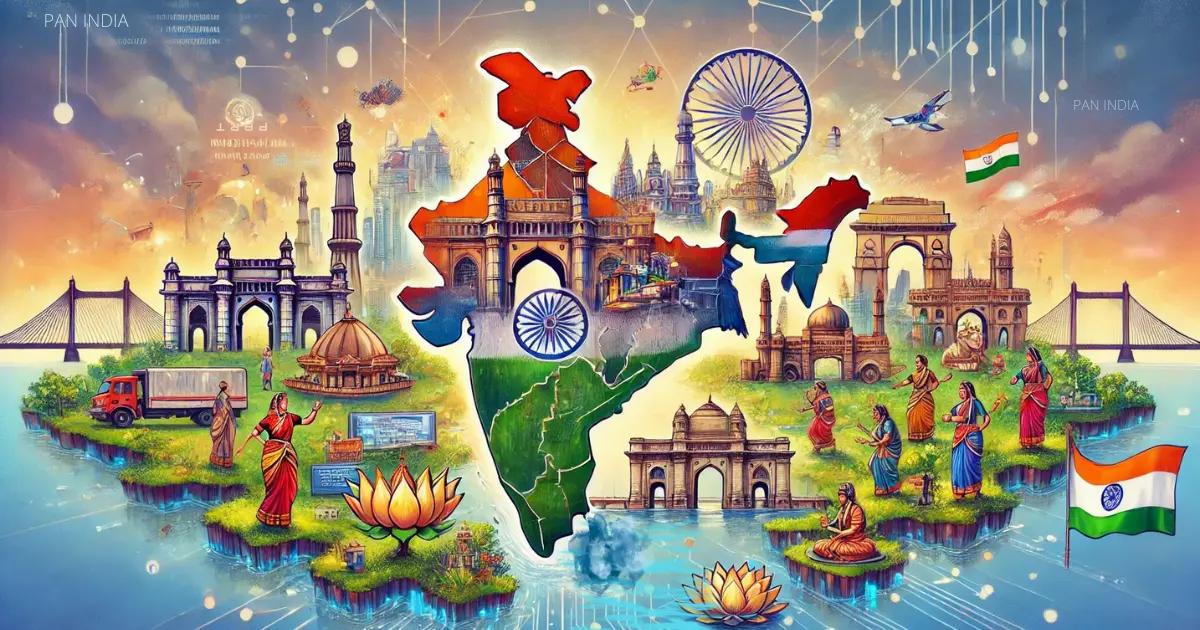
The term pan India meaning refers to something that spans across the entire nation of India, covering all states, union territories, and regions without geographical limitations. When a business, policy, film, or initiative is described as “pan India,” it indicates nationwide presence, reach, or applicability rather than being limited to specific regions or states. This concept has become increasingly important in modern India as businesses expand beyond regional boundaries, the government implements nationwide schemes, and the entertainment industry creates content that transcends linguistic and cultural barriers to appeal to audiences across the country.
Understanding what does pan India mean is essential for anyone following Indian business news, government policies, or the booming entertainment sector. The term appears frequently in discussions about corporate expansion strategies, central government initiatives, and especially in recent years, when describing blockbuster films that achieve success across multiple language markets. As India continues to integrate economically and culturally, the pan India approach has become a strategic imperative for organizations and creators seeking maximum impact and reach.
What Does Pan India Mean? (Simple Definition)
The pan India definition is straightforward: “pan” is a prefix derived from Greek meaning “all” or “every,” so pan India literally translates to “all of India” or “across all of India.” When applied to any context—whether business operations, government schemes, or entertainment releases—it signifies comprehensive coverage of the entire Indian subcontinent without exclusions based on geography, language, or regional boundaries.
In practical terms, a pan India presence means operating in or serving customers across multiple states and regions, rather than focusing on a single state or zone. For instance, a company with pan India operations would have business activities in North, South, East, West, and Central India, potentially serving customers in Tamil Nadu, Maharashtra, West Bengal, Rajasthan, and every other state. Similarly, a pan India film would be released simultaneously across the country in multiple languages, targeting audiences from diverse linguistic backgrounds.
The concept emphasizes inclusivity and nationwide scope. It’s important to note that pan India doesn’t necessarily mean equal presence or distribution everywhere—a company might have stronger operations in some regions than others—but it does mean the intention and capability to serve or reach the entire nation. This distinguishes pan India initiatives from regional ones, which deliberately focus on specific geographic or linguistic markets.
Origin and Etymology of the Term Pan India
The prefix “pan” has ancient Greek origins, where it meant “all,” “every,” or “whole.” This prefix has been adopted into English and many other languages to create compound words indicating universality or comprehensiveness—such as “panorama” (all view), “pandemic” (affecting all people), or “pan-American” (all of the Americas). The application of this prefix to India follows the same linguistic pattern, creating a term that conveys nationwide scope.
While the exact timeline of when “pan India” entered common usage in Indian English is difficult to pinpoint, the term gained significant traction during India’s economic liberalization in the 1990s. As businesses began expanding beyond their traditional regional strongholds and the central government started implementing nationwide schemes, the need for a concise term to describe this all-India approach became apparent. The term filled this linguistic gap perfectly, offering a more sophisticated alternative to phrases like “all over India” or “nationwide.”
The pan India full form is simply “pan” (meaning all) + “India” (the country)—there is no acronym involved, though some people mistakenly search for “PAN India full form in English” thinking it’s an abbreviation. This confusion likely arises because “PAN” is also a well-known acronym in India standing for “Permanent Account Number,” a tax identification number. However, when written as “pan India” (lowercase “pan”), it refers to the geographical concept of nationwide coverage, not the tax document.
Pan India in Business and Commerce
In the business world, pan India business strategies represent a major evolution from regional operations to nationwide market presence. Companies pursuing a pan India approach aim to establish their brand, products, or services across all Indian states and territories, creating a unified national market presence rather than remaining confined to specific regions where they originated or traditionally operated.
The pan India business model offers several strategic advantages. First, it provides access to India’s massive consumer base of over 1.4 billion people, allowing companies to achieve economies of scale that would be impossible in regional markets alone. Second, it reduces dependency on any single regional market, spreading risk across diverse geographic areas with different economic cycles and consumer preferences. Third, it builds stronger brand equity—a nationally recognized brand commands more trust and can charge premium prices compared to regional players.
However, executing pan India operations presents significant challenges. India’s diversity means businesses must navigate 22 official languages, vastly different cultural preferences, varying income levels, diverse regulatory environments at the state level, and infrastructure quality that differs dramatically between urban metros and rural areas. Successful pan India businesses invest heavily in understanding local nuances while maintaining brand consistency, often adopting a “glocal” strategy—thinking globally (or nationally) while acting locally.
The retail sector provides excellent examples of pan India expansion. E-commerce platforms like Amazon India and Flipkart have built pan India logistics networks that can deliver products to remote villages and major cities alike. Traditional retailers like Reliance Retail and Future Group have established thousands of stores across states, adapting their product mix to local tastes while maintaining operational standards. Even quick-service restaurant chains modify their menus regionally—offering more vegetarian options in Gujarat, spicier variants in Andhra Pradesh, and seafood-heavy menus in coastal areas—while maintaining their core brand identity nationwide.
Pan India Operations: Examples from Major Companies
Several Indian and multinational companies have successfully implemented pan India examples that demonstrate how nationwide operations can be executed effectively across diverse markets. These case studies offer valuable insights into the strategies, investments, and adaptations required for true pan India presence.
Reliance Industries exemplifies pan India operations across multiple sectors. Reliance Jio disrupted the telecommunications market by launching pan India 4G services simultaneously across all states in 2016, offering affordable data plans that transformed internet accessibility nationwide. Reliance Retail operates over 15,000 stores across India, from Reliance Fresh grocery stores to Reliance Digital electronics outlets, adapting to local preferences while maintaining operational excellence. Their supply chain infrastructure spans the entire country, enabling consistent product availability from Kashmir to Kanyakumari.
State Bank of India (SBI), the country’s largest public sector bank, maintains the most extensive pan India banking network with over 22,000 branches and 62,000 ATMs across urban centers, small towns, and rural villages. This pan India presence ensures that even residents of remote areas have access to banking services, supporting financial inclusion initiatives. SBI’s network demonstrates how pan India operations in essential services require physical infrastructure investments that private players might find economically unviable in less profitable regions.
Hindustan Unilever Limited (HUL) has built one of India’s most successful pan India consumer goods businesses. Their distribution network reaches over 9 million retail outlets across the country, ensuring products like Lux soap, Surf detergent, and Brooke Bond tea are available in metropolitan supermarkets and small village shops alike. HUL’s success stems from understanding regional preferences—they offer different product variants, packaging sizes, and price points tailored to local purchasing power and usage patterns while maintaining brand consistency.
Indian Railways, though a government entity, operates the world’s most extensive pan India transportation network, connecting virtually every corner of the country. With over 67,000 kilometers of track and 7,000 stations, it demonstrates how pan India infrastructure enables economic integration, allowing goods and people to move seamlessly across state boundaries. The railways’ pan India presence has been crucial for national unity and economic development since independence.
Pan India in Government and Governance
Pan India in government refers to policies, schemes, and administrative systems implemented uniformly across all states and union territories by the central government. Unlike state-specific programs, pan India government initiatives aim to ensure equal access to services, benefits, and opportunities for all Indian citizens regardless of their geographic location.
The Indian Constitution establishes the framework for pan India governance through the Union List, which specifies subjects on which the central government has exclusive authority—including defense, foreign affairs, currency, and interstate commerce. This constitutional structure enables the central government to implement pan India policies that supersede state boundaries, ensuring national cohesion and uniform standards in critical areas.
Pan India governance has become increasingly digital in recent years. The Aadhaar system, India’s biometric identification program, represents one of the most ambitious pan India initiatives ever undertaken. With over 1.3 billion enrollments, Aadhaar provides every resident with a unique 12-digit identification number linked to biometric data, enabling seamless verification for government services, banking, and various other purposes across the entire country. This pan India digital identity infrastructure has revolutionized service delivery and reduced fraud in subsidy distribution.
The Goods and Services Tax (GST), implemented in 2017, created India’s first truly pan India indirect tax system, replacing a complex web of central and state taxes that created barriers to interstate commerce. GST transformed India into a unified common market, allowing goods to move freely across state boundaries without cascading taxes. This pan India tax reform simplified compliance for businesses operating nationally and boosted economic efficiency.
Pan India governance also extends to law enforcement and security. The Central Bureau of Investigation (CBI) and National Investigation Agency (NIA) have pan India jurisdiction to investigate serious crimes and terrorism cases that cross state boundaries. Similarly, the Goods and Services Tax Network (GSTN) operates as a pan India digital platform connecting taxpayers, businesses, and government agencies across all states.
Pan India Schemes and Policies (Examples)
The Indian government has launched numerous pan India schemes designed to provide uniform benefits and services to citizens across the country, addressing issues like poverty, healthcare, education, and infrastructure development. These schemes demonstrate how pan India approaches can drive inclusive development and reduce regional disparities.
Pradhan Mantri Jan Dhan Yojana (PMJDY), launched in 2014, aimed to provide pan India financial inclusion by ensuring every household has access to a bank account. This pan India scheme has opened over 460 million accounts, bringing previously unbanked populations into the formal financial system. The scheme’s pan India implementation required coordination between public and private banks, extensive awareness campaigns in regional languages, and infrastructure development in remote areas.
Ayushman Bharat, the world’s largest government-funded healthcare program, provides pan India health insurance coverage to over 500 million economically vulnerable individuals. The scheme offers cashless treatment at empaneled hospitals across all states, allowing beneficiaries to access healthcare services anywhere in India, not just in their home state. This pan India portability ensures that migrant workers and travelers can receive medical care without geographic restrictions.
Pradhan Mantri Awas Yojana (PMAY) represents a pan India housing initiative aimed at providing affordable housing to urban and rural poor across the country. The scheme operates in all states and union territories, adapting to local construction costs and housing needs while maintaining uniform eligibility criteria and subsidy structures. This pan India approach ensures that housing support reaches beneficiaries from Ladakh to Lakshadweep.
National Education Policy (NEP) 2020 establishes a pan India framework for educational reform, though states have flexibility in implementation. The policy aims to standardize certain aspects of education—like the 5+3+3+4 curricular structure and emphasis on foundational literacy—while allowing regional customization in curriculum content and language of instruction. This balance between pan India standards and regional autonomy reflects the complexity of implementing nationwide policies in India’s diverse educational landscape.
Digital India initiative encompasses multiple pan India programs aimed at transforming India into a digitally empowered society. Components include pan India broadband connectivity through BharatNet, digital literacy programs, and e-governance platforms that allow citizens to access government services online from anywhere in the country. The initiative’s pan India scope requires massive infrastructure investments and capacity building across urban and rural areas.
Pan India in Entertainment and Cinema
The entertainment sector, particularly cinema, has witnessed a revolutionary shift with the emergence of pan India films—movies that transcend regional and linguistic boundaries to achieve nationwide success. The pan India film meaning refers to movies that are conceptualized, produced, marketed, and released with the intention of appealing to audiences across all Indian language markets, not just the film’s original language region.
Traditionally, Indian cinema operated in distinct regional silos—Hindi films dominated North India, Telugu and Tamil films served South Indian audiences, and other regional industries catered to their respective linguistic populations. Films rarely crossed these boundaries successfully, with Hindi cinema enjoying the widest reach due to Hindi’s status as a link language. However, the pan India film phenomenon has disrupted this model, with South Indian films achieving unprecedented success in Hindi-speaking markets and vice versa.
The pan India movie meaning extends beyond mere wide release. A true pan India film is designed from conception with a universal narrative that resonates across cultural boundaries, features high production values that match or exceed Bollywood standards, incorporates visual storytelling that transcends language barriers, and is released simultaneously in multiple dubbed versions—typically Hindi, Tamil, Telugu, Kannada, and Malayalam at minimum. The marketing strategy for pan India films is equally ambitious, with promotional campaigns conducted across all major markets rather than focusing primarily on the film’s original language region.
The rise of pan India cinema has been facilitated by several factors. Improved dubbing quality makes films accessible in multiple languages without losing emotional impact. Digital distribution and multiplexes have created uniform theatrical experiences across cities, reducing the infrastructure gap between different regions. Social media and streaming platforms have exposed audiences to content from other language industries, breaking down linguistic barriers and creating appetite for diverse storytelling. Most importantly, filmmakers have recognized that India’s total cinema market is far larger than any single regional market, making the investment in pan India releases financially attractive.
What Makes a Movie a Pan India Film?
Understanding what makes a movie a pan India film requires examining the specific characteristics that distinguish these productions from traditional regional cinema. Not every widely released film qualifies as a pan India film—the term implies a deliberate strategy and certain production qualities that enable nationwide appeal.
Universal storytelling forms the foundation of pan India films. These movies typically feature narratives with universal themes—heroism, revenge, love, sacrifice, or social justice—that resonate across cultural boundaries. They avoid region-specific cultural references, dialects, or humor that might not translate well to other markets. The storytelling relies heavily on visual spectacle, action sequences, and emotional moments that communicate effectively regardless of language. Films like “Baahubali,” “KGF,” and “RRR” exemplify this approach, using grand visual narratives that transcend linguistic barriers.
High production values are essential for pan India films. These productions typically have budgets that rival or exceed mainstream Bollywood films, investing heavily in visual effects, cinematography, production design, and action choreography. The quality must match audience expectations across all markets—viewers in Mumbai multiplexes and Chennai theaters should experience comparable production excellence. This requires significant financial investment, often ₹100-300 crores or more, which can only be recouped through pan India and sometimes international releases.
Star power with cross-regional appeal helps pan India films attract audiences beyond the star’s home market. While initially South Indian stars like Prabhas, Yash, and Allu Arjun built pan India appeal through their films’ success, increasingly actors are being cast with pan India potential in mind. The concept of a “pan India star” has emerged—actors whose popularity transcends their regional industry, commanding box office pull across language markets.
Simultaneous multi-language release strategy distinguishes pan India films from regional films that later get dubbed for other markets. Pan India films are released simultaneously in 4-5 major languages with extensive theatrical distribution across all regions. The marketing campaigns run concurrently in all markets with region-specific promotional activities. This requires coordination between multiple distribution networks and significant marketing investment across diverse media landscapes.
Genre selection plays a crucial role. Pan India films typically belong to genres with universal appeal—action, period dramas, mythological epics, or large-scale thrillers. These genres rely less on linguistic humor or cultural specificity and more on visual storytelling and emotional resonance. Conversely, genres heavily dependent on wordplay, regional humor, or specific cultural contexts rarely succeed as pan India films.
Benefits of Pan India Approach in Different Sectors
Adopting a pan India approach offers substantial benefits across business, governance, and entertainment sectors, though the specific advantages vary by context. Understanding these benefits explains why organizations increasingly pursue nationwide strategies despite the complexity and investment required.
In business and commerce, pan India operations provide access to a massive market of 1.4 billion consumers, enabling economies of scale that dramatically reduce per-unit costs. A company manufacturing products for pan India distribution can achieve production efficiencies impossible in regional operations, negotiating better terms with suppliers and spreading fixed costs across larger volumes. Brand recognition improves significantly—consumers across India develop familiarity with pan India brands through consistent presence and advertising, creating trust and loyalty that translates to pricing power and market leadership.
Risk diversification represents another crucial business benefit. Companies operating pan India aren’t dependent on any single regional economy—if one region faces economic downturn, drought, or other challenges, strong performance in other regions can offset losses. This geographic diversification stabilizes revenue and reduces vulnerability to localized disruptions. Additionally, pan India presence creates competitive barriers—new entrants face daunting challenges in matching the distribution networks, brand recognition, and operational scale of established pan India players.
For government and governance, pan India schemes ensure equitable service delivery and reduce regional disparities. Citizens in remote northeastern states receive the same benefits as those in developed western states, promoting national integration and social justice. Pan India policies also simplify administration—uniform rules, procedures, and systems reduce complexity compared to managing different schemes for each state. Digital pan India platforms like Aadhaar and GST Network create efficiency gains through standardization and interoperability.
Pan India governance enables better resource allocation and disaster response. The central government can mobilize resources from prosperous regions to support development in less developed areas, promoting balanced growth. During natural disasters or emergencies, pan India systems allow rapid deployment of aid and coordination across state boundaries. The COVID-19 pandemic demonstrated this benefit—pan India vaccination platforms and supply chains enabled coordinated nationwide response impossible under fragmented state-level systems.
In entertainment and cinema, pan India films access a market several times larger than any single regional industry. A successful pan India film can gross ₹500-1000 crores or more, compared to ₹100-200 crores for a regional blockbuster. This expanded market justifies larger production budgets, enabling filmmakers to create more spectacular visual experiences. Pan India success also elevates actors, directors, and technical crew to national prominence, opening opportunities for brand endorsements, future projects, and international recognition.
The pan India approach in entertainment has cultural benefits too—it exposes audiences to diverse storytelling traditions, breaking down linguistic and regional prejudices. A Telugu audience watching a Hindi film or vice versa promotes cultural exchange and national integration. Streaming platforms benefit enormously from pan India content libraries, offering subscribers diverse entertainment options that justify subscription costs and reduce churn.
Challenges of Implementing Pan India Strategies
Despite significant benefits, implementing pan India strategies presents formidable challenges that explain why many organizations struggle to achieve true nationwide presence. These obstacles span logistical, cultural, regulatory, and financial dimensions, requiring careful planning and substantial resources to overcome.
Linguistic diversity poses the most obvious challenge. India recognizes 22 official languages and hundreds of dialects, making communication with customers, employees, and stakeholders complex. Businesses must translate marketing materials, product information, and customer service into multiple languages while ensuring cultural appropriateness—direct translations often fail to convey intended meanings or inadvertently cause offense. Entertainment companies face even greater challenges, as dubbing quality significantly impacts viewer experience, and poorly dubbed content can doom otherwise excellent films.
Cultural and regional preferences vary dramatically across India, requiring extensive customization despite pan India branding. Food preferences differ radically—vegetarianism dominates in Gujarat and Rajasthan, while non-vegetarian cuisine is preferred in Kerala and West Bengal. Religious sensitivities, festival calendars, color symbolism, and aesthetic preferences vary by region. Companies must balance standardization for efficiency with customization for relevance, a tension that requires sophisticated market understanding and flexible operations.
Infrastructure disparities create operational challenges. While metros and tier-1 cities have world-class infrastructure, rural areas and smaller towns often lack reliable electricity, internet connectivity, and transportation networks. A pan India business must design operations that function effectively in both contexts—requiring different logistics strategies, technology solutions, and service models for different regions. This dual-system approach increases complexity and costs significantly.
Regulatory complexity remains challenging despite reforms like GST. While the central government sets many policies, states retain authority over areas like labor laws, land acquisition, alcohol sales, and various licensing requirements. A company operating pan India must navigate 28 different state regulatory environments, each with unique procedures, timelines, and political considerations. This regulatory fragmentation increases compliance costs and slows expansion.
Talent acquisition and management presents difficulties for pan India operations. Finding employees with appropriate skills, language capabilities, and cultural understanding for each region requires extensive recruitment efforts. Transferring employees between regions often meets resistance due to family ties, language barriers, and cultural adjustment challenges. Building a unified corporate culture across diverse regional offices while respecting local norms requires sophisticated human resource management.
Financial investment requirements for pan India presence are substantial. Building distribution networks, establishing regional offices, conducting market research, creating localized marketing campaigns, and developing region-specific products require capital that many organizations lack. The return on investment timeline extends over years, testing investor patience. Many companies attempt pan India expansion prematurely, before achieving profitability in their home regions, leading to overextension and failure.
Competition intensity increases in pan India markets. Regional players defend their home territories fiercely, leveraging superior local knowledge and relationships. Simultaneously, other pan India competitors vie for market share. This multi-front competitive battle requires resources and strategic sophistication that overwhelm many organizations. Success demands not just adequate resources but also strategic clarity about competitive positioning and differentiation.
Pan India vs Regional: Key Differences
The distinction between pan India vs regional approaches represents a fundamental strategic choice for businesses, government programs, and entertainment productions. Understanding these differences helps organizations make informed decisions about their geographic scope and resource allocation.
Market scope and size represent the most obvious difference. Regional strategies focus on specific states or linguistic zones—a Tamil Nadu-focused business, a Northeast-specific government program, or a Marathi film targeting Maharashtra audiences. This limited scope means smaller total addressable markets but potentially deeper penetration and understanding. Pan India approaches target the entire nation, accessing a market 10-20 times larger but requiring proportionally greater investment and facing more complex execution challenges.
Cultural specificity differs significantly. Regional approaches can embrace local culture deeply—using regional dialects, referencing local history and heroes, incorporating region-specific humor, and aligning with local values and traditions. This cultural specificity creates strong emotional connections with target audiences but limits appeal beyond the region. Pan India approaches must find universal themes and expressions that resonate across cultures, sacrificing some depth of local connection for breadth of appeal.
Resource requirements vary dramatically. Regional operations require modest investment—a single distribution network, one language for marketing, understanding one regulatory environment, and building relationships with one set of stakeholders. Pan India operations multiply these requirements across dozens of regions, demanding substantially larger capital, human resources, and management bandwidth. A regional player might operate profitably with ₹10-50 crores investment, while pan India presence might require ₹500-1000 crores or more.
Competitive dynamics differ between regional and pan India markets. Regional markets often have entrenched local players with deep community relationships, political connections, and cultural understanding that outsiders struggle to match. However, regional markets are also smaller, potentially limiting growth. Pan India markets face competition from other national players with comparable resources, making differentiation more challenging but offering larger rewards for success.
Risk profiles contrast sharply. Regional strategies concentrate risk—if the regional economy declines, a natural disaster strikes, or political instability emerges, the entire business suffers. Pan India strategies spread risk across geographies, but also expose organizations to more potential disruption points. A pan India company faces risks from 28 state governments, diverse economic conditions, and varied social dynamics, though no single regional problem threatens the entire operation.
Brand positioning opportunities differ. Regional brands can position as authentic local champions, leveraging regional pride and identity. Pan India brands position as national leaders, offering consistency, reliability, and prestige associated with nationwide presence. Neither positioning is inherently superior—the choice depends on target audience values and competitive context.
The question “Is it PAN India or all India?” often arises. Both terms are essentially synonymous, though “pan India” has become the preferred business and media terminology due to its conciseness and slightly more sophisticated connotation. “All India” remains common in government contexts and everyday speech. Some organizations use “national” as another synonym, though this can be ambiguous since “national” might refer to central government rather than geographic scope.
Future of Pan India Initiatives in India
The future of pan India initiatives appears increasingly promising as technological, economic, and social trends converge to make nationwide integration more feasible and valuable. Several developments will shape how pan India strategies evolve across sectors in coming years.
Digital infrastructure expansion will be the primary enabler of future pan India initiatives. The government’s BharatNet program aims to connect all 600,000 villages with high-speed broadband, while 5G rollout will bring advanced connectivity to urban and rural areas alike. This digital infrastructure will enable pan India e-commerce, telemedicine, online education, and digital financial services to reach previously underserved populations. Businesses will be able to serve customers in remote areas as efficiently as urban centers, reducing the infrastructure gap that currently complicates pan India operations.
Artificial intelligence and machine learning will help organizations manage the complexity of pan India operations. AI-powered translation services will enable real-time communication across languages, reducing linguistic barriers. Machine learning algorithms will help businesses understand and predict regional preferences, enabling mass customization at scale. Automated compliance systems will navigate complex multi-state regulations, reducing the administrative burden of pan India operations.
Unified digital identity and payments infrastructure will continue maturing. Aadhaar-based authentication and UPI payment systems have already transformed how pan India services are delivered. Future developments will enable seamless, paperless, presence-less service delivery across the country—citizens will access government services, financial products, and commercial offerings without geographic constraints. This digital foundation will make pan India operations dramatically more efficient and accessible.
Continued economic integration through reforms like GST will reduce interstate barriers further. Future reforms may harmonize more state-level regulations, simplify land acquisition procedures, and create truly uniform business environments. As economic integration deepens, the distinction between regional and pan India operations will blur—operating nationwide will become the default rather than an ambitious expansion strategy.
Cultural homogenization and diversification will occur simultaneously. Increased mobility, social media, and pan India entertainment will create more shared cultural references and values across regions, making pan India marketing easier. Paradoxically, this will also increase appreciation for regional diversity—pan India platforms will showcase regional content to national audiences, creating markets for specialized regional products and content within pan India frameworks.
Climate change and sustainability will drive pan India approaches in new sectors. Water management, renewable energy distribution, and climate adaptation will require pan India coordination and infrastructure. Companies developing sustainable solutions will need pan India scale to achieve viability, while government climate initiatives will necessarily be pan India in scope given the interconnected nature of environmental challenges.
Entertainment industry evolution will see the pan India film model become standard rather than exceptional. As audiences increasingly consume content across language barriers via streaming platforms, filmmakers will routinely conceptualize projects for pan India release. The distinction between “Bollywood,” “Tollywood,” and other regional industries will become less relevant as a unified Indian cinema industry emerges, producing content for the entire nation and international markets.
Healthcare and education will see transformative pan India initiatives. Telemedicine platforms will provide pan India access to specialist consultations, while online education platforms will offer uniform quality education across urban and rural areas. Government schemes will increasingly leverage digital infrastructure to deliver healthcare and education services pan India, reducing the urban-rural and inter-state disparities that currently characterize these sectors.
The concept of “pan world meaning” may also emerge as Indian companies expand internationally. Just as pan India means covering all of India, pan world or pan global would indicate worldwide presence. Several Indian companies—from IT services to pharmaceuticals to automotive—are already achieving pan global operations, applying lessons learned from managing pan India complexity to international expansion.
In conclusion, the pan India meaning encompasses far more than simple geographic coverage—it represents a strategic approach to serving India’s diverse population through unified systems, policies, and offerings that transcend regional boundaries. Whether in business, governance, or entertainment, pan India initiatives have become essential for achieving scale, impact, and national integration in the world’s most populous democracy. As digital infrastructure matures and economic integration deepens, pan India approaches will become increasingly feasible and valuable, shaping India’s development trajectory in the decades ahead. Organizations that master the complexity of pan India operations—balancing standardization with localization, leveraging technology while respecting cultural diversity, and investing for long-term presence rather than short-term gains—will be best positioned to succeed in India’s dynamic and rapidly evolving market.
Frequently Asked Questions
What does 'pan India' truly mean?
Pan India means something that covers or applies to the entire nation of India, spanning all states, union territories, and regions without geographical limitations. The term “pan” comes from the Greek prefix meaning “all” or “every,” so pan India literally translates to “all of India.” When used in business, governance, or entertainment contexts, it indicates nationwide presence, reach, or applicability rather than being restricted to specific regions or states.
What is the difference between PAN India and all India?
“Pan India” and “all India” are essentially synonymous terms that both refer to nationwide coverage across the entire country. However, “pan India” has become the more modern, professional terminology commonly used in business, media, and corporate communications. “All India” is the traditional phrase often used in government contexts and older institutions, while pan India meaning has gained popularity in contemporary usage, especially in the corporate and entertainment sectors.
What is a PAN India company?
A PAN India company is a business organization that operates across the entire nation of India, with presence, services, or distribution networks spanning all or most states and union territories. These companies are not limited to regional markets but have established nationwide operations, customer bases, and brand recognition. Examples include major corporations like Reliance, Tata Group, and HDFC Bank that maintain operations from Kashmir to Kanyakumari.
Why is it called PAN India?
It is called PAN India because the prefix “pan-” derives from the Greek word meaning “all,” “every,” or “whole,” indicating complete coverage. When combined with “India,” it creates a term that signifies something encompassing the entire Indian subcontinent without regional restrictions. This terminology became popular as India’s economy liberalized and businesses began expanding beyond traditional regional boundaries to establish truly national operations.
What does PAN stand for in India?
In the context of “pan India,” PAN is not an acronym but rather a prefix meaning “all” or “encompassing everything.” However, PAN also stands for Permanent Account Number in India’s taxation system, which is a completely different concept. The Permanent Account Number is a unique 10-digit alphanumeric identifier issued by the Income Tax Department, while the pan India meaning refers to nationwide coverage or presence.
What is a Pan India movie?
A Pan India movie is a film produced and released across the entire country, transcending regional and linguistic boundaries to appeal to audiences nationwide. These films are typically made with high budgets, released in multiple languages simultaneously, and marketed across all Indian states. Recent examples include blockbusters like “Baahubali,” “RRR,” and “KGF,” which achieved massive success beyond their original language markets by creating universal appeal.
What are PAN India cities?
PAN India cities refer to major urban centers distributed across the entire country that collectively represent nationwide geographical coverage. These typically include metropolitan areas and state capitals from all regions—north, south, east, west, and central India—such as Delhi, Mumbai, Bangalore, Kolkata, Chennai, Hyderabad, and others. When businesses or services claim presence in “PAN India cities,” they indicate operations in multiple major cities across different states and regions.
What is the role of PAN India in business expansion?
The pan India approach plays a crucial role in business expansion by enabling companies to maximize market reach, diversify revenue streams, and reduce regional dependency. Operating on a pan India basis allows businesses to tap into diverse consumer markets, leverage economies of scale, and build stronger brand recognition nationally. This nationwide presence also provides competitive advantages, risk mitigation through geographical diversification, and opportunities to serve India’s growing middle class across all regions.
You May Also Like

Car Finance Claims Explained: Check for Hidden Costs

Water Taxi Market 2025: Sustainable Growth Forecast & Trends

Visionary Leader Impact: Howard Wilner’s Expert Insights