Why Proper Electrical Grounding Matters for Home Safety

Grounding is one of those electrical concepts that most homeowners have heard of but few actually understand. It does not show up in the finishes you see or the fixtures you pick out, but it plays a bigger role in your home’s safety than almost anything else in the electrical system.
If your home has ever tripped a breaker for seemingly no reason, or if you have noticed a slight tingle touching an appliance, grounding issues are often the hidden cause.
What Does Grounding Actually Do?
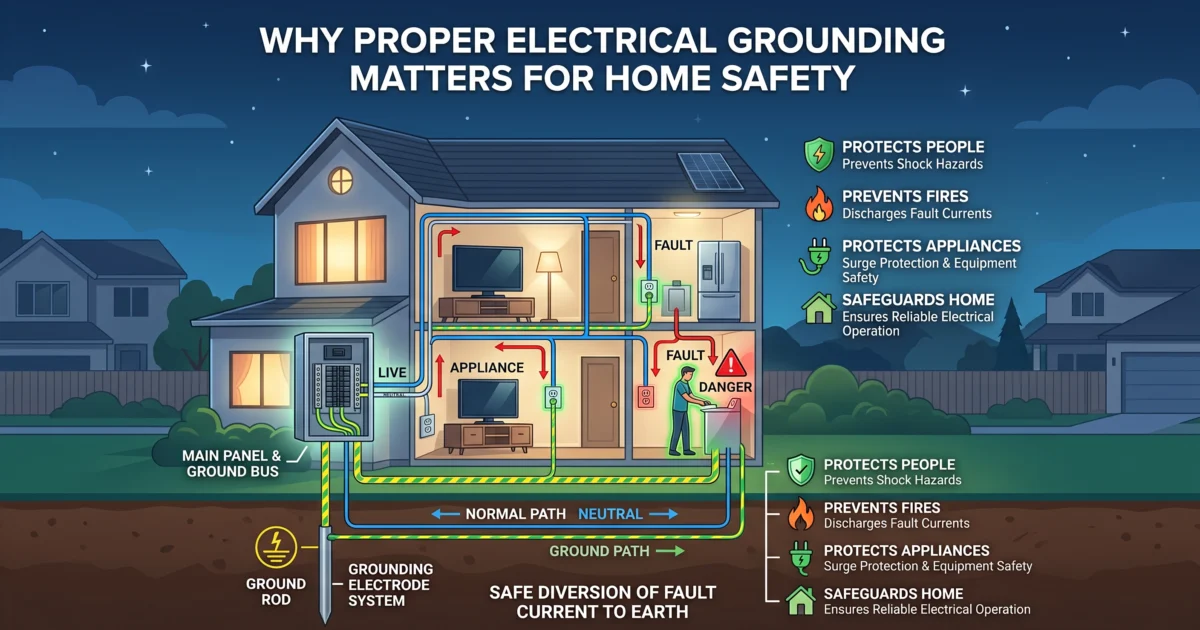
At its core, grounding gives electricity a safe path to travel if something goes wrong. Wiring is designed to carry current along a specific route, but faults happen. A wire loosens, insulation wears down, or a device malfunctions internally.
Without proper grounding, that stray electricity has nowhere predictable to go. It might travel through the metal casing of an appliance, through a person touching it, or through anything else that happens to be nearby. A grounding system gives that current a direct, safe path back to the panel instead, tripping a breaker before anyone gets hurt.
What Are the Signs of a Grounding Problem?
Grounding issues are not always obvious, which is part of what makes them dangerous. A few signs worth paying attention to:
Outlets that only have two prongs instead of three, especially in homes built before the 1960s. This usually means the circuit was never grounded to begin with.
A mild shock or tingling sensation when touching an appliance, especially one with a metal exterior like a dryer or refrigerator.
Frequent, unexplained breaker trips that do not seem tied to a specific overloaded circuit.
Flickering lights that happen independently of any appliance turning on or off.
Any of these on their own is worth a second look. Together, they usually point toward a grounding issue somewhere in the system.
Why Do Older Homes Have Grounding Issues?
Grounding requirements have changed significantly over the decades. Homes built before the 1960s often used two prong outlets and ungrounded circuits as standard practice, simply because the code at the time did not require otherwise.
As homes have been renovated and expanded over the years, it is common for some circuits to get upgraded while others get left alone. This creates a patchwork system where part of the home is properly grounded and part of it is not, which can be confusing to diagnose without a full inspection.
Homeowners in Wildwood dealing with an older property often benefit from bringing in an electrician in Wildwood MO to map out exactly which circuits are grounded and which ones still need attention, rather than assuming the whole home is either fine or a total loss.
Does Grounding Affect More Than Just Safety?
Grounding is not only about preventing shocks during a fault. It also protects your electronics. Surges from lightning strikes, utility fluctuations, or even large appliances cycling on and off can send unexpected voltage through your system.
A properly grounded home gives that excess voltage somewhere to go besides your television, computer, or HVAC control board. Homes without solid grounding tend to see more electronics damaged over time from surges that a grounded system would have absorbed or redirected.
This becomes especially relevant as more homes fill up with sensitive electronics, from smart thermostats to home security systems, all of which are vulnerable to voltage spikes in ways older appliances never were.
How Is Grounding Different From GFCI Protection?
These two terms get confused often, but they solve different problems. Grounding provides a physical path for stray electricity to follow. GFCI protection, found in outlets near water sources like kitchens and bathrooms, monitors current flow and shuts off power almost instantly if it detects an imbalance.
A home can technically have GFCI protection on individual outlets without being fully grounded elsewhere, but the two work best together. GFCI outlets add a layer of protection against shock, while grounding addresses the underlying path electricity takes when something fails.
If you are unsure whether your home has one, both, or neither, that uncertainty itself is a good reason to have things checked rather than assuming you are covered.
What Does a Grounding Inspection Involve?
A grounding inspection typically starts with testing individual outlets and circuits to confirm they are properly connected back to the panel and, from there, to a grounding rod outside the home. This process can reveal circuits that look fine on the surface but are not actually grounded correctly.
The panel itself gets checked too, since grounding issues sometimes originate there rather than at individual outlets. Corroded connections or a grounding rod that has degraded over time can undermine the whole system even if the wiring elsewhere is in good shape.
Depending on what the inspection finds, fixes can range from a simple rewiring of a few outlets to a more involved correction at the panel level.
Final Thoughts
Grounding rarely gets the attention it deserves because it does not affect how your home looks or feels day to day. But it is one of the most important safety systems working quietly in the background, protecting both people and electronics from the unpredictable moments when something in the system fails.
If your home shows any of the warning signs mentioned here, or if you simply are not sure where things stand, having a professional evaluate your grounding system is worth the peace of mind it provides.
You May Also Like
Roofers Newcastle: What Homeowners Should Know Before Hiring

Is My House Good for Solar Panels? Complete 2026 Guide
Solar Panels on Mobile Homes: Complete Installation Guide 2026